
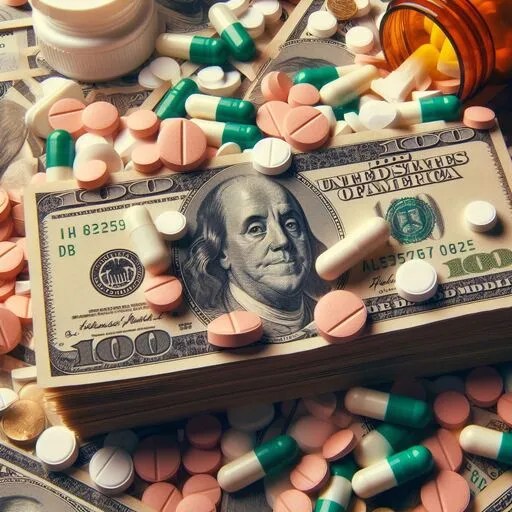
This image was created with the help of Microsoft Designer
Comparing a book to The Bible says a lot about this book.
It points to the high impact it has on a particular field of knowledge and expertise. It also reflects an absolute trust the readers of the book have in its content — and its authors.
The Diagnostic and Statistical Manual of Mental Disorders, a book published by the American Psychiatric Association, is considered “the bible” of psychiatry. It sets the golden standards for diagnostics of psychiatric disorders and provides sought-after treatment guidelines.
Given its ability to broaden diagnostic categories and recommend which drugs should be prescribed, the manual plays a central role in the approval process for new psychiatric drugs and the patent extension for existing.
It is therefore crucial that the book’s authors are free of any “external” influence or conflict.
That’s why it was so shocking to learn that many contributors to the manual took money from the pharmaceutical industry.
Using open sources of financial information, a group of academic researchers has found that in the years preceding the publication of the latest version of the manual, 55 contributors have collectively received a total of $14.2 million of drug money.
The most common type of payment was for food and beverages followed by travel and consulting; however, in dollar amounts, the greatest part of contributions (more than 70 percent) was for research funding.
The investigative team has concluded that their findings “raise questions about the editorial independence of this diagnostic manual.”
To my taste, this is a remarkably restrained conclusion. The study reminds us of a seemingly small change to the criteria for attention deficit/hyperactivity disorder (ADHD) introduced in the 2013 edition of the manual. The change was expected to result in a considerable increase in the diagnosis of ADHD and the number of drug prescriptions.
Indeed, a 2021 review found convincing evidence of overdiagnosis and overtreatment of ADHD in children and adolescents.
Editorial independence? It’s a conflict of interest at its purest.
Spreading the Bets
If you ever spoke to a financial advisor, this is one thing you will surely remember: diversify your investments.
The pharma industry has certainly learned this lesson: it does diversify the range of recipients of drug money. Scientists are one category; another one are patient advocacy groups.
Patient advocacy groups (PAGs) are non-profit organizations dedicated to supporting patients living with a specific illness or health condition. As I wrote in my previous article, PAGs play an important role in various aspects of patient well-being:
- They collect information about specific disorders (symptoms, diagnoses, treatment options, and latest research advancements) and share it with patients, caregivers, and the broader public.
- They offer emotional support, peer-to-peer connections, practical guidance, and resources to navigate the challenges of living with a disorder.
- They contribute to medical research by sharing patient experiences and facilitating data collection that helps improve care for the specific condition.
I also mentioned that implicit in the concept of patient advocacy is a belief that all the decisions made by PAGs are made in the interest of patients — and only patients — without being influenced by other considerations.
It was therefore troubling to read a recent report by Public Citizen, a consumer watchdog, revealing that in 2010–2022, 31 drug companies and their major lobbying group, Pharmaceutical Research and Manufacturers of America (PhRMA), have been providing money grants to major PAGs.
In particular, the American Heart Association (AHA) received $8.3 million from Pfizer, the manufacturer of Tafamidis, the most expensive cardiovascular drug ever launched in the United States. The American Cancer Society (ACS) received $6 million from AstraZeneca, $4.7 million from Merck, and $3.4 million from Pfizer, all manufacturers of expensive cancer drugs.
Why is this troubling?
With high drug prices remaining a serious — and growing — healthcare problem, PAGs are expected to push for the drug cost reduction for their patients.
Recently, they got an additional tool: the 2022 Inflation Reduction Act (IRA) gives Medicare the ability to negotiate drug prices with manufacturers.
One would expect PAGs to voice strong support for using the negotiation process to drive down the cost of at least most expensive drugs. And yet, both AHA and the American Cancer Society Cancer Action Network, an ACS affiliate, were both silent on this topic.
Was their reluctance to support the negotiation provision of the IRA a consequence of their receiving drug money? A question we’d all love to know the answer to.
(To be fair, not all recipients of drug money took the same position. The American Diabetes Association received $26.4 million from the drug industry; yet the group supported the $35 monthly cap on out-of-pocket costs for insulin included in the IRA.)
Funding the Regulator
Did you know that the Food and Drug Administration (FDA) collects the so-called user fees?
Those are monies that companies pay to the FDA when they apply for approval of a medical device or drug. Manufacturers also pay annual user fees based on the number of approved drugs they have on the market.
Supporters of the user fees argue that the adoption of the system in 1992 has allowed the FDA to streamline its operations and to significantly increase the speed of the approval process. For example, in 1987, it took the FDA 29 months to approve (or reject) a new drug; in 2018, this number was down to only 10 months.
What is concerning is that today, the user fees make up 46 percent (yes, 46!) of the FDA’s $7.3 billion budget — and 65 percent of the funding for human drug regulatory activities.
Think about this: almost half of funding for a government regulatory body comes from the entities this body regulates.
Are there reasons for concern? Experts believe there are. While the speed of the approval process has increased, so has the number of drugs with serious safety issues coming to light after the approval. It was reported that since the user fee act was approved, the number of such unsafe drugs has increased from 21 to 27 percent.
Is this increase a consequence of inevitable mistakes accompanying a speedy process? Or is it a reflection of a “softer” approach the FDA takes on its benefactors?
Another question we’d all love to know the answer to.
One thing is clear to me: if we want to decrease the influence of drug money in healthcare, the FDA budget would be the place to start. Finding additional $3.3 billion — the amount of money the FDA gets from the user fees — is a small price to pay for the safety of the American people.

 innovationobserver.com