
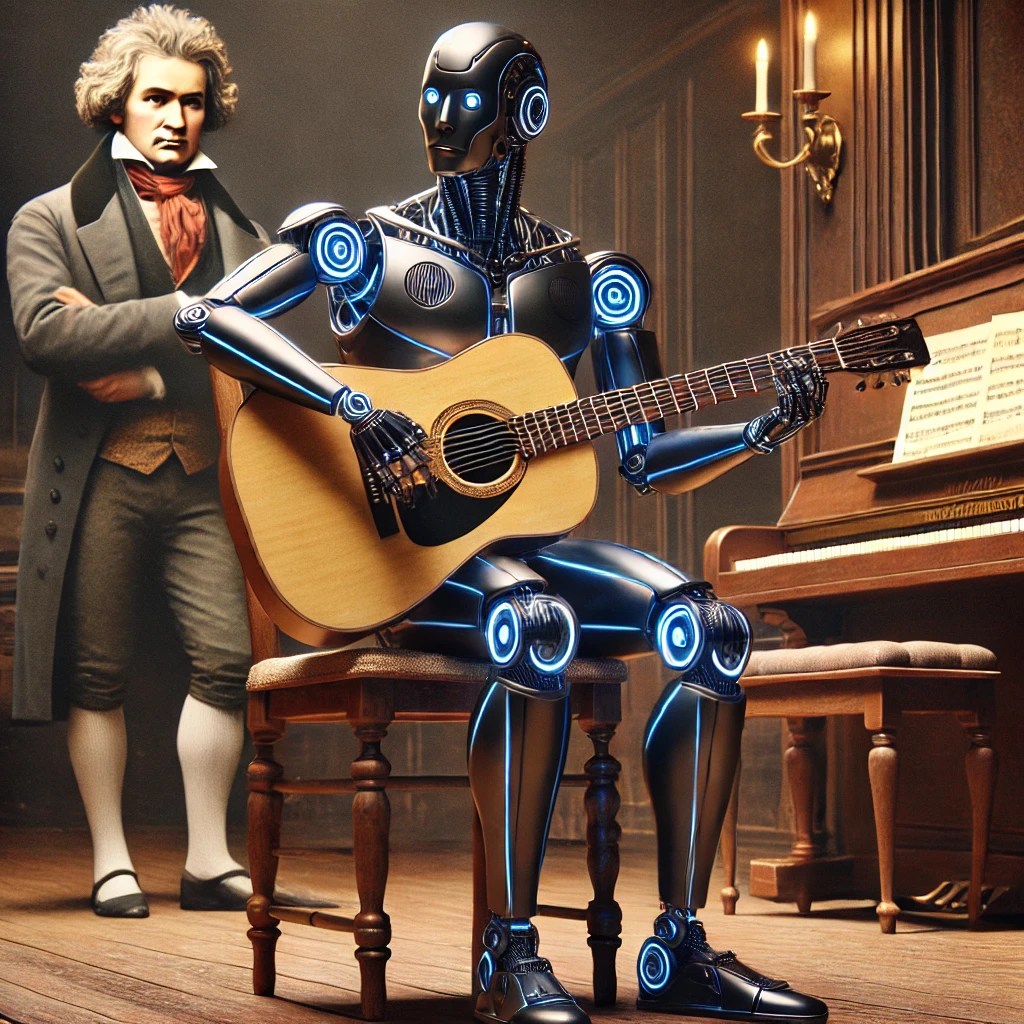
As Artificial Intelligence (AI) keeps conquering creative fields, from visual arts to music, the debates on whether AI can be truly “creative” show no signs of abating. But a much more practical question is, do listeners perceive AI-composed music differently from human-composed?
Two recent studies, one by Shank et al. (2022) and another by Zlatkov et al. (2023), explore these questions and reveal interesting insights into how people judge AI-generated music.
Do We Like AI-Composed Music Less?
The study by Shank et al. (2022) investigated whether people like music less when they believe it was composed by AI. In a first set of experiments, participants listened to excerpts of classical and electronic music and rated how much they liked them while also guessing whether they were composed by a human or AI. The results showed that listeners were more likely to assume that electronic music was AI-composed and tended to like it less if they believed this was the case.
In the next set, the researchers directly manipulated the information given to listeners about composer identity. They found that for classical music, participants liked the excerpts less when they were told it was AI-generated. This suggests a clear bias against AI composers, particularly in genres, like classical music, that are traditionally associated with human emotional expression and creativity.
…Or We Don’t Care?
The study by Zlatkov et al. (2023) explored a similar question from a different angle. Their experiment involved 163 participants who listened to five human-composed and five AI-composed musical pieces. The participants were divided into two groups: one was told the correct composer identity, while the other was deceived. The researchers hypothesized that those who knew that a piece was AI-generated would rate it lower.
Surprisingly, the evidence didn’t support this hypothesis. Unlike previous findings, Zlatkov et al. found that listeners did not necessarily dislike music just because it was AI-generated. However, researchers acknowledged limitations in their study design as they didn’t explore the role of musical style, listener background, and other contextual factors in shaping perceptions of AI-composed music.
…And Should We Care?
Both studies provide yet another example of the complexity of human perception of AI creativity. While one suggests that people have an inherent bias against AI-generated music, particularly when it challenges traditional notions of musical craftsmanship, the other indicates that this bias may not be as universal as previously thought; instead, it depends on context and how AI music is introduced to listeners.
The larger point, however, is that AI-composed music is good enough to fool people into believing that it was human-generated.
So, as AI-generated music becomes increasingly sophisticated, it’s not its quality but rather human perception that will represent a major hurdle to its adoption. Whether AI compositions will ever be embraced on equal footing with human-created music will therefore depend not just on technical advancements but also on changing cultural attitudes toward creativity itself.
And let’s be honest. You’re listening to a piece of music that gets you. Does it matter who—or what—composed it?

 innovationobserver.com
Pingback: In Silico Creativity. Part 3. AI and Creative Art |