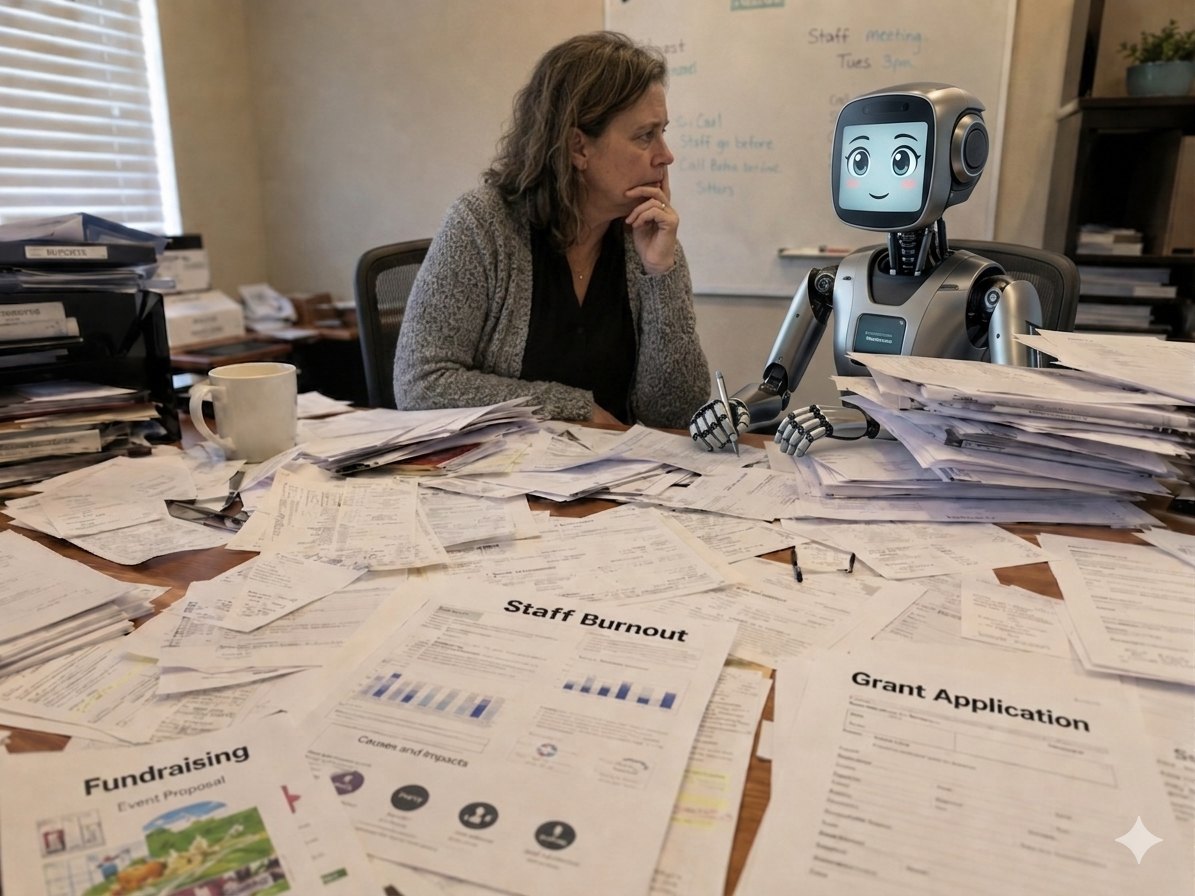
There is a moment in many conversations about the nonprofit crisis when someone says, “But what about AI?”
The question is reasonable. Technology is real, the capabilities are growing fast, and the appeal to resource-stretched organizations is obvious. If AI can write grant proposals, summarize research, handle administrative tasks, and analyze program data — all at a fraction of traditional cost — then surely it offers some relief to a sector that is under pressure.
It does. And it doesn’t. The distinction matters enormously, and it is worth being precise about it.
The State of Nonprofits 2026 report surveyed 380 nonprofit leaders across the country and found that one in five is currently considering using AI tools to reduce operational costs. That is not surprising. When funding is tightening, staffing is strained, and burnout is accelerating — the same report found that nearly half of nonprofit CEOs describe their own burnout as a serious personal concern, up from under a third just a year ago — any tool that promises efficiency is going to attract attention.
The question is not whether nonprofits should use AI. Many already do, and most of them will. The question is what they are using it for, and whether that use is making them more effective or simply more efficient at what they were already doing.
Those are not the same thing.
The Efficiency Trap
AI is extraordinarily good at a specific category of tasks: processing, generating, and organizing explicit knowledge. It can draft documents, surface patterns in data, synthesize research, answer questions, and accelerate workflows. Applied to the right problems, it is genuinely transformative. Applied to the wrong ones, it produces something more insidious than failure. It produces the appearance of progress.
Consider two scenarios that are playing out in the sector right now. A nonprofit uses AI to generate more grant proposals — faster, better written, more professionally formatted than anything its small staff could produce alone. The proposals go out. Some are funded. The organization grows. But no one has paused to ask whether its programs are addressing the root causes of the problem it exists to solve, or whether years of accumulated assumptions about who needs help and why have quietly hardened into unexamined certainties. The AI has accelerated the operation. It has not improved the diagnosis.
Or consider a community organization that uses AI to automate and scale its client outreach — more contacts, faster response times, broader reach. The metrics look good. But the people being reached most efficiently are not necessarily the people most in need of services. The algorithm optimizes for what it can measure. What it cannot measure — the neighbor who doesn’t respond to digital outreach, the family that doesn’t know help exists, the community that distrusts institutions — becomes invisible precisely because the tool is working so well.
In both cases, the AI works. The process it is applied to doesn’t. This is what automating dysfunction looks like. It is not dramatic. It doesn’t announce itself. It simply makes organizations faster and more productive at pursuing objectives that were never rigorously defined in the first place.
If you haven’t defined your problem correctly, AI will efficiently generate sophisticated answers to the wrong question.
The Knowledge Gap
There is a second, less obvious reason why AI underdelivers in the nonprofit context, and it has to do with the nature of the knowledge these organizations possess.
AI operates on explicit knowledge — information that has been articulated, documented, and made available in a form the system can process. What it cannot access, by definition, is tacit knowledge: the hard-won expertise that lives in the heads of experienced staff, accumulated through years of frontline work, refined through thousands of interactions with clients and communities. This knowledge — who shows up and why, what language lands and what doesn’t, which interventions work in this neighborhood with this population under these conditions — is often the most valuable thing a nonprofit has. It is also almost entirely uncodified.
Most nonprofits don’t have a solid body of documented institutional knowledge. High turnover, constant operational pressure, and minimal administrative capacity mean that expertise walks out the door with every staff departure and has to be rebuilt from scratch. AI cannot compensate for this gap — it can only work with what has been made explicit. And in many cases, what has been made explicit is the surface of the organization’s knowledge, not its depth.
This gap — between the ocean of AI-accessible information now available to nonprofits and the interpretive infrastructure required to use it well — is precisely where problem-solving failures live.
What AI Actually Offers
None of this is an argument against using AI. It is an argument for using it correctly, which means using it within a structured process rather than as a substitute for one.
The real value of AI for nonprofits is not in generating answers. It is in improving the quality of questions. When deployed inside a rigorous problem-solving process — one that begins with honest diagnosis, interrogates assumptions, and defines the problem before designing solutions — AI becomes something these organizations have rarely been able to afford: a thinking partner.
It can help surface assumptions that have gone unexamined. It can challenge problem framing. It can map potential root causes and stress-test proposed solutions before resources are committed. It can do in hours what would otherwise take weeks, if the process directing it is sound.
Without that process, it does something else entirely. It accelerates. It scales. It makes organizations look modern while leaving the underlying dysfunction untouched.
Looking modern but performing no better is not progress. It is a more expensive version of standing still.
The sector is under enormous pressure, and the temptation to reach for powerful tools is completely understandable. But the organizations that will navigate this moment most effectively will not be the ones that adopt AI fastest. They will be the ones that define their problems most clearly — and then use every tool available, including AI, in the service of that clarity.
That is what the next part of this series is about.
This is the third article in a series on nonprofits, problem-solving, and what it takes to help organizations become more effective at achieving their missions.


Pingback: A Way Through (What structured problem-solving offers the nonprofit sector) |