
A house with a roof but no walls

Back in 2005 or 2006, I was on a business trip in Germany. One night, I was having dinner with a business partner of mine, an innovation manager at a large German chemical company. We chatted about this and that, and I casually remarked that while open innovation was making good inroads in business practices in the United States, its progress was significantly slower in Europe, Germany being no exception.

“I can easily explain that to you,” told my dinner partner, “the reason is our labor laws.”

I put down my fork. “What do your labor laws have to do with open innovation?” 

“Well,” was his response, “when you guys in the U.S. want to lay off people, you’re free to do so. But here in Germany, you can’t fire people at will. So, before launching an open innovation initiative, our management wants to make sure that all our own people are fully employed.”

While certainly amused by my partner’s take on the nature of labor relations in the U.S., I wasn’t totally surprised. The perception that open innovation was taking away R&D jobs was alive and well in many tech companies across America. Of course, such a perception didn’t make preaching the open innovation gospel any easier.

Times change and public opinions change with them. Today, no one seriously believes that open innovation takes away any jobs. (I guess, the honor now belongs to Artificial Intelligence.) Yet, the true place of open innovation in the corporate innovation toolbox remains far from settled.  

* * *

A friend of mine, an innovation manager, likes to joke: “Innovation is simple…but not easy.”

There is a reason for this uneasiness. Modern corporations, especially large ones, are obsessed with execution. Predictability of outcomes and the precise match between plans and achieved results are the metrics against which firms measure their performance and that of their employees. 

But innovation is messy. By its very nature, it’s highly unpredictable and relies on constant experimentation with most experiments ending up in failure. The lack of the predictability of outcomes makes innovation difficult to plan, especially when firms attempt to move their innovation goalposts beyond the incremental improvement of existing products.

Open innovation kicks it up a notch to this complexity by increasing the level of uncertainty: now, one needs to innovate with someone outside the corporate walls. This immediately triggers a round of additional concerns and complications.

First, internal innovation teams often interpret the introduction of open innovation as a vote of no confidence in their abilities to achieve the firm’s strategic innovation goals. So-called Not Invented Here Syndrome (NIHS), a rejection by internal teams of ideas and solutions that did not originate within the firm, almost inevitably ensue. (One should realize that the NIHS affects internal innovation, too, but this is a topic for a separate conversation.)  

Second, the perspective of working with “strangers” terrifies the firm’s legal department. Everyone who tried to initiate an open innovation project from within a private company would immediately remember a monstrous volume of paperwork and a ridiculous number of questions starting with “What if someone…?” A bordering on insane, the worst-case scenario speculation follows.

Finally, adding to the adoption problems is widespread confusion over open innovation tools. Some of them, such as crowdsourcing, are not terribly intuitive and need training and experience to use. Worse, what is often missing is a clear understanding that each specific open innovation tool is only good when applied to a matching innovation task. Tool mismatching—when a specific tool is being chosen without careful consideration of its applicability—is depressingly common. (I’ll return to this last point in a separate post.

* * *

At this point, many firms make a mistake that may appear tactical but in fact, can have a serious negative strategic impact: they create a separate open innovation team (that is, not formally a part of the larger corporate innovation unit).

Why do I think this is a mistake?

Corporate innovation requires extensive internal business development, a process by which members of the innovation team try to “sell” new ways of solving problems to other, often skeptical, corporate functions and units.

This isn’t easy by itself but with the added complexity that comes with open innovation, this internal business development often becomes a nightmare. A small open innovation team (it’s always small because open innovation teams are routinely under-resourced) is struggling to find internal clients to do things that sound complicated and often counterintuitive. It’s like going door-to-door around a neighborhood offering a product no one has heard of.

That’s why I strongly believe that in firms that are just starting using open innovation approaches systematically, the open innovation team must reside within a larger corporate innovation unit. This way, selling its “products” will become more organic and therefore more manageable.

Of course, as the open innovation program matures, the team will grow and at some point, may branch out. But starting with a separate open innovation team from the start is a sure way to set it up for failure. 

* * *

For someone who for the past 15+ years has been preaching the virtues of open innovation, this might be a strange confession to make. But I’ll make it nonetheless: there is no such thing as open corporate innovation.

There is only innovation, a process that drives the firm’s strategic growth. This innovation has a single body, one side of which is composed of tools utilizing the collective wisdom of the firm’s own employees. The other side of this body extends to the rest of the world trying to reach out to the diverse pools of global talent.

Creating open innovation programs without establishing internal first looks to me like a tree without roots. Or, if you prefer, a house with a roof but no walls.

No, no, and once again, no! I’m not saying that firms should postpone experimenting with open innovation until they establish internal innovation programs first (which may take years).  My point is that the full potential of open innovation can only be realized by the concerted effort of properly connected people within a firm capable of identifying and properly defining their own needs. Or, saying this differently, the power of open innovation comes from the strength within.

Image credit: https://thechurchwithoutwalls.com/believe/

Posted in Innovation, Internal Innovation Networks | Tagged , , , | 1 Comment

The last mile of the marathon

A few years ago, my daughter ran her first marathon. She then decided to take a short break from running: first, to get a well-deserved rest for her body, and second, to take care of business left neglected due to the rigorous schedule of pre-marathon training.

She returned to the trail 2-3 weeks later to run her first post-marathon routine, only 3-mile long. Although her body felt perfectly rested, my daughter was surprised how difficult it was to finish the distance. “You would expect that someone who’s just run 26 miles shouldn’t feel troubled with running only three,” complained she over the phone, “yet, I’ve barely made it.”

We talked a bit about that, and it became apparent to both of us that my daughter’s problem was mental, not physical. When she set her mind on running the whole 26 miles, the first 20 felt almost like a regular training; the real struggle began during the last few. But when she knew that the target was only three miles, the most difficult last mile began almost instantly.

I see an interesting parallel here with how firms set their corporate innovation targets.

Yes, I know: these targets must be realistic (SMART, CLEAR, PURE, you name it). Setting unrealistic targets are said to increase the probability of failure, which, despite our professed passion for celebrating it, still damages the innovation team’s morale and credibility, to say nothing about the team members’ bonuses and career prospects.

We therefore quietly settle on what is euphemistically called “early wins,” which are no more than easily achievable half-targets. And yet, we then often struggle to hit even these relaxed targets because…well, because the most difficult last mile begins almost instantly.

One can routinely hear complaints that corporate innovation is too incrementalas opposed to being disruptive. In fact, there is nothing wrong with incremental innovation: it represents a key part of any balanced innovation portfolio. The problem arises when incremental innovation is not a well-planned and carefully executed project aimed at improving the firm’s core offerings, but rather an aborted attempt at innovating something larger and more ambitious.

It’s like instead of covering the whole marathon distance, we run until we feel that our muscles are numb, and our lungs gasping for air. At which point, we walk off the trail and declare mission accomplished (and celebrate an early win).

In a recent HBR article, Antonio Nieto-Rodriguez argues that when evaluating and prioritizing projects, looking at the business case alone isn’t enough. Firms also need to understand how the project connects to what the author calls higher purpose. It is defining projects for their purpose that is the best way to understand whether or not they make sense strategically.

I fully agree. Successful corporate innovation requires many things: strong executive leadership, well-defined innovation strategy, functional innovation governance, tools and processes, talent management, etc., etc., etc.

But every innovation project begins with a goal, with a destination. And only after defining this destination it is possible to choose the luggage you’ll carry during the bumpy innovation journey.

It’s like when leaving your house in running gear in the morning, you should know what you’re up to: to run the full marathon or just to jog for a few miles before breakfast.

Image credit: https://blog.strava.com/london-marathon-hayley-carruthers-17902/

Posted in Innovation | Tagged , , , , | Leave a comment

The questions we ask

In my previous post, I argued that the proper definition of a problem is the most important part of any innovation initiative, in particular, crowdsourcing campaign. Inspired by the Pareto Principle, I call it the 80:20 rule of crowdsourcing: 80% of unsuccessful crowdsourcing campaigns failed because the problem presented to the crowd was not properly defined; only 20% did so because of a poor match between the problem and the crowd’s capabilities.

The process of problem definition isn’t easy, but it can be learned. Unfortunately, many organizations, especially those new to crowdsourcing, simply don’t understand the importance of this process. They mistakenly believe that they can ask the crowd almost anything, in any form, and then it will be up to the crowd to figure out what needs to be done.

This is the wrong approach, and although it may sound self-serving, having around someone with experience in running crowdsourcing campaigns would be helpful.

This reminds me of a project I once had with a client, a pharmaceutical company. My client wanted to design a high throughput screening (HTS) assay to study a specific type of cellular transformation, a process by which normal cells become precancerous.

To those unfamiliar with HTS assays, I will say that pharmaceutical companies routinely use them for drug discovery because HTS assays allow to screen literally tens or even hundreds of thousands of chemical compounds for biologic activity. Although HTS assays employ robotics and sophisticated software, at their core they are still a “regular” assay: you start with a normal cell, you add a test compound, and you watch for something that indicates that the transformation you’re interested in has taken place.

My counterpart at the client site, the head of the assay development group, confidently listed the most important parameters the future assay was expected to have: volume (the number of samples analyzed per hour or day), the ratio of so-called false positives and false negatives (two key parameters defining the assay’s accuracy), and the cost (as cheap as possible. But of course.).

While listening to her and taking notes, I began to sense that something very important was still missing. Finally, I found an opportunity to interrupt: “All right, everything is clear. But what about the endpoint? What is your endpoint?” (In most assays, the endpoint is the thing that the assay physically measures.)

For a split second, my client lost her confidence. She paused and then said, carefully choosing her words: “Well, we do not have an endpoint. We thought that finding it would be part of the whole solution.”

It was now my turn to carefully choose what I was about to say. “Well, perhaps, we’re asking too much. What if we start by looking for a suitable endpoint and then, after we have found it, we’ll run a follow-up campaign to design an HTS assay based on this endpoint?”

She broadly smiled in response: “Look, if we had a good endpoint, we wouldn’t need you: my in-house assay developers will design an HTS version of the assay in a matter of weeks.”

That ended our discussion. Shortly, the two of us put together a problem statement asking for a molecule whose change in quantity or structure within cells would signal that the cellular transformation in question had taken place.

We posted the statement online, and in about a week or two, I got a submission from a solver living in one of the small Eastern European countries. The submission described a protein (I had never heard of it before) that was overproduced by the cells that had experienced the transformation my client was interested in. This overproduction could be easily detected by measuring the intensity of fluorescence, a slam dunk for any assay developer.

Frugally written, only a half-page in length, the submission had a couple of paragraphs of text, a picture, and a reference. But it was nevertheless something I could share with my client.

Her response followed almost immediately: “I love it! We’re buying this solution.”

And that was it. I completed the paperwork transferring all intellectual property rights to the solution to my client. I never heard from her again: apparently, her in-house assay developers were indeed as good as she described them.

Image credit: https://www.criver.com/products-services/discovery-services/screening-and-profiling-assays/assay-development/ion-channel-assays?region=3601

Posted in Crowdsourcing, Innovation | Tagged , , , , | Leave a comment

How to win a war

What do you need to win a war?

A few things. First, you need an army equipped with superior weapons and instilled with high spirits. Second, you need a vibrant economy capable of sustaining the hardship of continued military operations. Third, you need strong public support of the country’s political and military leadership.

Did I forget anything? Oh, one more thing: you need an enemy. And not just any enemy, a bogeyman created to justify the war, but the enemy, a thorn in your side that needs to be removed ASAP.

Finding the true enemy is usually (but not always) easier in the case of military operations. But we Americans love to launch wars against everything we consider a threat to our society. That’s where defining the enemy becomes tricky.

Take President Johnson’s 1964 War on Poverty. By failing to identify the root causes of poverty, the federal government has since been shelling the elusive enemy with 92(!) federal programs. According to a 2016 study, the federal government spent $668 billion on antipoverty programs, with state governments another $284 billion. The result? The poverty rate in the U.S. has been steady over the past 50 years, fluctuating between 10 and 15%.

Or take the War on Drugs launched by President Nixon in 1971. Since its inception, the initiative has received over $1 trillion in funding, but by focusing on fighting drug traffickers instead of treating drug addicts, the War on Drugs has miserably failed to eradicate illegal drug use.

The only arguably bright spot in our fight against social maladies has been President Nixon’s War on Cancer. By identifying molecular targets responsible for malignant growth and then designing drugs specifically attacking these targets, scientists have been able to dramatically decrease the death rate for many types of cancers. The total cancer death rate in the United States fell 25% from its peak in 1991. (An analogy with using special forces instead of regular troops immediately springs to mind.)

* * *

Now, I’m not a great fan of using military terminology for non-military topics (or the baseball terminology for non-sports conversations, for that matter). Yet, it’s tempting to compare a crowdsourcing campaign to a military operation.

To begin with, you need a large and competent crowd (your “army”), properly motivated, to solve a problem. But even more importantly, you must define this problem (your “enemy”) so that the crowd can attack it in the most effective way. Failing to do so will make your enemy elusive and your campaign unfocused and, inevitably, unsuccessful.

I call it the “80:20 rule”: in my experience, some 80% of unsuccessful crowdsourcing campaigns failed because the problem presented to the crowd was not properly defined; only 20% did so because of a poor match between the problem and the crowd’s competence.

* * *

Clients always come to me knowing what they want. Unfortunately, very often they don’t do enough preliminary work to understand what they need.

I remember a client who wanted to crowdsource a new design of a paint pump because it often clogged when dispersing paint. We investigated the problem a bit further and found that the cause of clogging was not the pump. Rather, the clogging occurred because the viscosity of the paint would sharply increase with a slight drop of the surrounding temperature (usually when using the pump outside in cold weather). The client fixed the clogging problem without running a crowdsourcing campaign by simply changing the composition of the paint.

I remember another client who wanted to crowdsource an additive that would prevent a food product they were manufacturing from losing sweetness upon processing. It took a lot of effort to persuade the client to leave the door open for solutions that would include modifications of the food preparation process itself. (“No, we can’t change the process; it’s too expensive!”). To my client’s great surprise, someone came up with a solution proposing a minor, inexpensive change in the preparation process that led to the same desired result: the preservation of sweetness.

It’s tempting to say that what clients want is a symptom of a disease whereas what clients really need is the cause of it. You can’t successfully cure the disease (solve the problem) unless you identify its real cause (define the problem).

But enough terminological exercises! Let me finish with formulating my first rule of crowdsourcing: know what you want, understand what you need.

Image credit: https://www.reddit.com/r/vexillology/comments/56mi3j/flag_in_an_old_painting

Posted in Crowdsourcing, Innovation | Tagged , , , , , , , | 1 Comment

A stranger in the room

Better decisions come from teams that include a “socially distinct newcomer

(Kellogg School of Management News, 2009)

What role do external consultants play in shaping corporate innovation?

Steve Blank, one of the greatest innovation thinkers of our times, seems to discount this role. In Blank’s opinion, “innovation won’t come from plans or people outside your company–it will be found in the people you already have inside who understand your company’s strengths and its vulnerabilities.”

I agree with Blank: like revolutions, innovation can’t be imported. The full potential of corporate innovation can only be realized by the concerted effort of properly connected people within firms capable of identifying and defining their own needs. Or, saying the same differently, the power of corporate innovation comes from the strength from within.  

And yet, I do believe external consultants may play an important role in helping firms innovate.

Sure, employees are vastly superior to any outsider in knowing their firm’s business. Besides, they have a strong vested interest in the firm’s future.

But outsiders have at least one undeniable advantage over insiders: they’re not exposed to the often-toxic fumes of internal politics. That helps them better deal with competing ideas and opinions, judging them on their merits rather than on their authorship.

And then, there is this luxury to be a “stranger in the room,” not knowing the ways things “have always been done here” and being naïve enough to keep asking stubborn whys when everyone else in the room already knows the right way.

I fully appreciated the magic power of a “naïve” question after having a memorable meeting with one client, a pharmaceutical company.

As often happens, the meeting was organized in haste, and the only thing I was told was that the client wanted to discuss phosphorus-containing detergents.

I thought I knew what that meant. This pharmaceutical company used phosphorus-containing detergents to clean production vessels after each manufacturing cycle. But phosphorus-containing compounds, notoriously environmentally unfriendly, had been steadily falling under regulatory scrutiny; it was only a matter of time before the regulatory authority, the U.S. Food and Drug Administration, would ban using them altogether.

I knew from my previous interactions with this client that they wanted to act proactively and switch to detergents based on more environmentally safe organic acids, as some of their competitors had already done.  Having assumed that the client wanted to crowdsource the optimal composition of a new cleaning solution, I spent my flight time reading relevant articles that I managed to collect before rushing to the airport.

The next morning, I was sitting in a room with five managers responsible for cleaning the manufacturing equipment. A nice breakfast was served, and, judging from my prior visits, a delicious lunch was to follow by noon.

After a few minutes of discussing the latest football scores, I got down to business: “OK guys, do you want to identify the best phosphorus-free cleaners?”

“No,” responded the gentleman in charge of the meeting on the client side, “there are plenty of commercially available cleaners based on citric acid. We know precisely what we want to use.”

I felt a bit puzzled: “So, what is the problem?”

“The problem is that there is a strong resistance inside the manufacturing unit to switching from a phosphorus-containing cleaner to the one based on citric acid. We tried, but it didn’t work.”

Feeling even more puzzled, I asked: “Who in the company has the authority to make this decision? Have you talked to this person?”

By the silence that followed, I realized that completely unwillingly I had put my hosts in an awkward position. They should have felt embarrassed that such a simple, obvious to even a stranger, solution had somehow escaped their attention.

The managers exchanged uneasy glances, and the one in charge uttered: “Well, we don’t actually know…”

Another manager rushed to help: “We’ll find out and bring this issue to the table. Perhaps, the situation isn’t as bad as it appears…”

Barely in its fifteenth minute, our four-hour-long workshop was over. We chatted for a few more minutes, discussing potential next steps, but I already knew that this team would never contact me again. (I was correct.) Apparently mindful of the fact that I was deprived of lunch, my hosts paid the cab fare to the airport.

I managed to change my mid-afternoon flight for an earlier one, and my watch was telling me that I would be home well before dinner. I was sitting in a half-empty airport terminal lit with the bright morning sun and sipped coffee bought from the nearby Starbucks. Life was good.

Image credit: https://well.blogs.nytimes.com/2009/12/01/why-loneliness-can-be-contagious/

Posted in Global Innovation, Innovation | Tagged , , , , | Leave a comment

Traveling unchartered innovation waters with Innovation Charter

(An earlier version of this piece was posted last year to the HeroX blog)

A few years ago, I came across an innovation survey, sponsored by Wazoku. Its results shocked me. 

Full 85% of respondents to the survey–board members, senior and middle managers, and line workers at large UK enterprises–considered innovation important to their companies. So far, so good. Yet 53% of surveyed managers were unaware of their company’s definition of innovation and how it fit into wider corporate goals. And 38% said innovation wasn’t their responsibility because it wasn’t in their job descriptions.

So much for a popular corporate tune: in our company, innovation is everyone’s job!

A lack of understanding of what innovation means for firms remains one of the most serious problems facing corporate innovation. Even C-level executives aren’t immune to this disease, but at the lower organizational levels, almost everyone is infected.

Obviously, no single fix exists to solve the problem. However, for firms that are yet to develop a structured innovation process–and also the ones that struggle to run working innovation programs–I’d recommend a solution that may look deceptively simple (worse, outright bureaucratic) but may prove surprisingly effective. 

The solution is to create a corporate Innovation Charter.

There are three immediate reasons why the Innovation Charter can help firms innovate better.

The Innovation Charter defines corporate innovation strategy

The major objective of the Innovation Charter is to spell out what innovation means for this specific firm. Not humanity, not whole industry. This specific firm.   

It should start with explaining where the firm stands today and where it wants to be in the future. It should then describe how the gap between “now and then” is to be bridged, and what role innovation should play in this process.

The clarity about the place innovation occupies within the general corporate strategy will help select and support matching innovation programs (and not just a generic cocktail of hackathons, idea-generation extravaganza, and fast and often failure festivities).

Equally important, the Innovation Charter will help create a common innovation language, the lack of which often results in a communication wall between corporate innovation team and the rest of the firm.

The Innovation Charter extracts maximum (vis-à-vis innovation, of course) out of the CEO

CEOs are routinely blamed for the lack of attention to innovation, and I myself is guilty as charged.

But let’s face it: they are very busy people in charge of everything. It’s plain unrealistic to expect them to pay unwavering attention to innovation, a continuous, often behind-the-scene process, which lacks frequent “events” and shows no obvious need for day-to-day executive intervention.

So, instead of asking the CEO for constant checking in, the innovation team should create the Innovation Charter and ask the CEO to publicly endorse it. With this endorsement, the innovation team can claim executive support even when the attention of the executive leaders will inevitably shift to other priorities.

It’s tempting to call the Innovation Charter the innovation law of the land. Of course, like any other law, it will need periodic re-enforcement, but will still keep maintaining order even when there are no cops around.

The Innovation Charter makes innovation “everyone’s job”

Corporate innovation can become much more efficient if it’ll expand from traditional R&D or product development units to departments that are not directly involved in the innovation process (manufacturing, finance, HR, etc.). Unfortunately, very often, the corporate structure is too rigid, too “anti-matrix,” to allow innovation to become “everyone’s job.”

Realistically, not everyone in the firm will be willing to assume an extra load that participation in innovation activities demands—and that’s fine. But even those who want to get involved, often can’t do so because of the pressure of their regular jobs.

Besides, attempts at expanding innovation activities throughout the whole firm are often met with resistance at the level of all-powerful middle managers. Unwilling to sabotage corporate innovation initiatives openly (especially if endorsed by the CEO), they often resort to implicit sabotage by not allowing their reports to get engaged on the ground that those are “too busy.”

This is a series problem with no ready-to-go fix to it. But here, too, the Innovation Charter can help because it provides an explicit mandate to anyone in the firm to get their feet wet in the whole-firm innovation waters, something that even their managers can’t easily ignore.

Or, to say it differently, the Innovation Charter adds innovation activities to everyone’s job description at once. Kind of.

Image credit: https://www.britannica.com/story/which-waters-do-you-pass-through-when-you-sail-the-seven-seas

Posted in Innovation | Tagged , , , , , | Leave a comment

Internal innovation: overcoming the dangers of remote work

Pessimists are said to be the happiest people on earth, for they celebrate when their own predictions don’t come true.

There was a shock wave of panic last spring when, due to the COVID-19 pandemic, firms around the globe had to switch to remote work, suddenly and en masse.

One can, therefore, easily understand the sense of relief, almost euphoria, filling the air when the captains of industry realized that switching to remote work hadn’t resulted in the immediate collapse of the corporate world.

Remote work works and has a future. That was a conclusion of a report composed by Upwork, a freelance marketplace, based on online surveys of corporate managers conducted at the end of April 2020. (Given that only a few weeks passed after the beginning of the remote work “experiment,” the conclusion of the report looks a bit rushed up, doesn’t it?)

Yet, voices of pessimists on the other side of the barricade were heard already, too. Some academics warned that online communications, a hallmark of remote work, were characterized by lower information sharing—and that meant the increased likelihood of poor decision-making in the short term and the reduced exchange of ideas between the employees in the longer term.

Now, just published data suggests that the pessimistic predictions about potential danger of remote work holds a lot of truth.

Innovation in peril?

A group of researchers from Microsoft analyzed communication practices of 61,182 U.S. Microsoft employees before and after Microsoft’s shift to firm-wide remote work. The major observations were as follows:

  • Remote work caused business groups within Microsoft to become less interconnected.
  • Remote work reduced the number of ties within the company’s informal collaboration network and caused employees to spend less time collaborating with the ties that remained.
  • Remote work caused employees to collaborate more with their stronger ties, which are better suited for information transfer, and less with weak ties, which are more likely to provide access to new information.
  • Remote work caused employees to communicate more via asynchronous media channels (email and IM), which are better suited for conveying information, and less via synchronous ones (video and phone calls), which are better suited for converging on the meaning of complex information.

Summing up their results, the authors concluded that shifting to remote work made Microsoft’s collaboration network more siloed, more static, and less “rich.” And although the authors didn’t directly measure any innovation outcomes, they fully expect that the effects on innovation of changing collaboration and communication patterns will be negative in the long term.

A sober conclusion, given that Microsoft postponed the employee return to the office—yet again.

Internal innovation networks to the rescue

Now matter what you think about the “letter” of the Upwork report, its “spirit” is right on point. Remote work is here to stay. So, the major question right now is how to minimize the potential negative consequences of remote work on innovation.

The answer lies in plain sight: internal innovation networks (IINs).

Although IINs provide organizations with many benefits, two are particularly relevant to overcome the shortfalls of remote work.

First, IINs provide a communication channel between different corporate functions and units that often have no institutional framework to discuss strategic issues. By providing such a channel, IINs create a common intellectual space, which not only allows to exchange complex information but also to facilitate an in-depth discussion of it.

Second, by hosting innovation contents and competitions, open to the whole company, IINs enhance and formalize existing weak ties. This may result in the creation of a new knowledge, which is often superior to the one created within established hierarchical teams.

This is not to say, of course, that firms should abandon or even scale down the existing external/open innovation initiatives. The point here is that the full innovation potential of any organization can only be realized by the concerted effort of connected employees capable of identifying and defining their own problems.

Regardless of whether we’re living in “normal times” or in the case of an emergency.

Image credit: https://www.newcybersource.com/network-solutions/

Posted in Crowdsourcing, Innovation, Internal Innovation Networks | Tagged , , , , , , | 1 Comment

Yes, size matters. It’s just not that the bigger is always the better

Among many of Jeff Bezos’s wisdoms, his two-pizza rule is one of the most famous. It states that every internal team should be small enough that it can be fed with two pizzas–to make meetings more effective and the teams more innovative.

When it comes to scientific research, the world seems to disagree with Bezos. As large-scale scientific collaboration become increasingly popular, research groups grow bigger and bigger. A world record seems to belong to a physics paper published in 2015: 5,154 authors. Only the first nine pages of the 33-page article describe the research itself; the rest (24 pages) lists the authors and their affiliation. Just imagine how many pizza parlors would have to work overtime to provide a single lunch for this tight-knit group of collaborators!

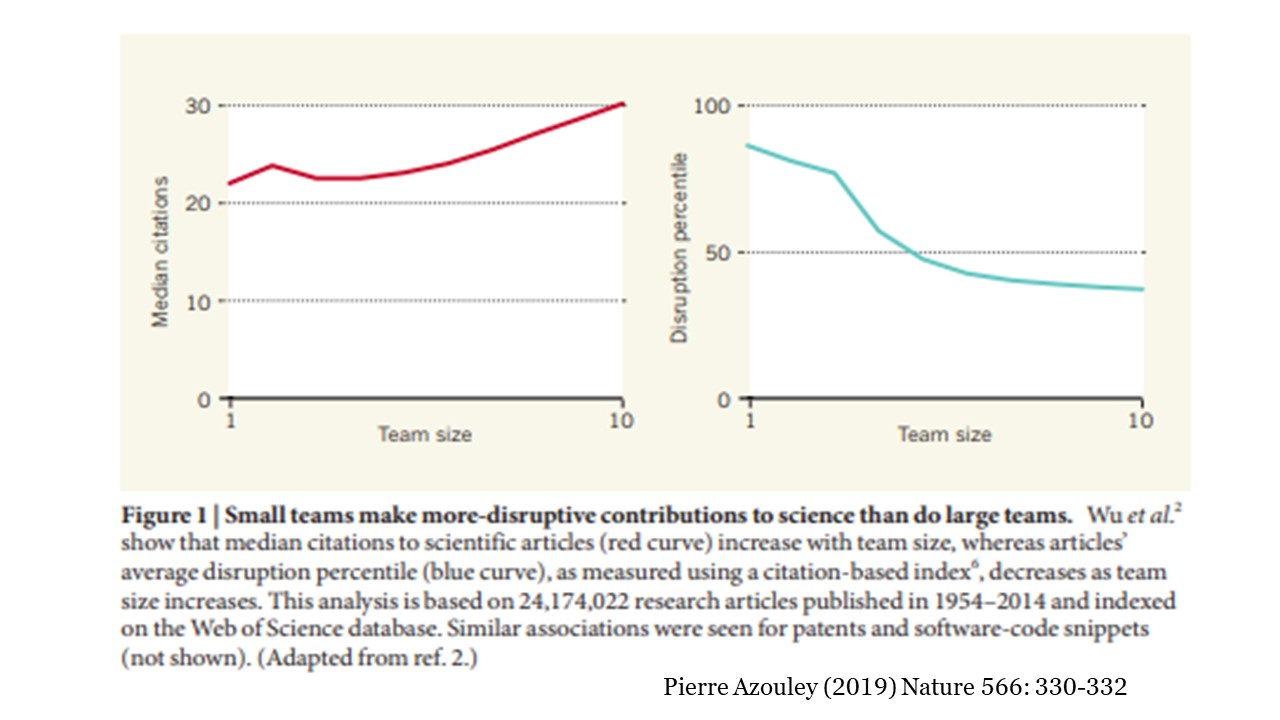
The proponents of “the bigger, the better” approach can point to at least one argument in support of their position: a positive correlation between a team’s size and a citation impact of a product that this team had produced. This correlation holds not only for STEM research, but also for social sciences, art and humanities, and patents. The bigger the team of collaborators, the greater the buzz their work is generating.

And yet, Bezos might have had the last laugh—as usual.

A group of authors led by James A. Evans of University of Chicago designed an advanced, more nuanced citation-based index capable of discriminating between “disruptive” and more conventional (“consolidating”) research contributions. Their logic was as follows: when future citations to a given article also reference a substantial proportion of that article’s own references, then the article can be seen as consolidating its scientific domain. However, when future citations do not acknowledge the article’s own references, the article can be seen as disrupting its domain[1].

Evans and his co-authors analyzed more than 65 million articles, patents, and software products generated over 1954–2014. They show that smaller teams tend to come up with more new ideas and opportunities (disruptive contribution), whereas larger teams tend to develop existing ones (consolidating contribution).


The authors also show that work from larger teams often builds on more recent and popular developments, so that attention to their work comes immediately. By contrast, contributions by smaller teams go more deeply into the past and, if successful, project further into the future.

My first impulse is to apply the result of Evans and his collaborators to the incremental vs. disruptive innovation dichotomy. When pursuing incremental (so tempting to say, consolidating) innovation, organization would seem to benefit from creating larger teams that could rapidly expand on recent product development gains. On the other hand, achieving disruptive innovation goals would be more plausible by establishing many small groups pursuing diverse projects—mimicking essentially the approach used by VC investors.

I also wonder if eating a particular type of pizza—say, Neapolitan vs. New York-style—would benefit a specific type of innovation.

Just kidding.

[1] For example, the index shows that articles directly contributing to Nobel prizes tend to exhibit high levels of disruptiveness; at the other extreme, review articles tend to be highly “consolidating.”

Image credit: https://adenuniversity.us/business-magazine/discover-the-two-pizza-rule-that-jeff-bezos-uses-to-have-more-productive-meetings/

Posted in Creativity, Innovation | Tagged , , , , | Leave a comment

A few words about innovation and leadership

I remember reading, a few years ago, a report with inspiring title “Unleashing the power of innovation.” To get a sense of what’s going on with innovation around the world, the authors of the report approached 246 CEOs and served them with a set of softball questions.

The respondents didn’t disappoint. Yes, we see innovation as a priority to our companies. Yes, we consider ourselves innovation leaders and visionaries as opposed to being simply sponsors of innovation programs. Of course, strong business leadership and right culture are the key ingredients for innovation success. Sure, we take personal responsibility for directing and inspiring innovation.

Nice, isn’t it.

My sense of tranquility was suddenly shaken, though, when I reached the last question of the survey asking about constraints stopping the CEOs from “being more innovative.” Three top answers to this question were: “Financial resources,” “Existing organization culture” and “Lack of talent.”

Wait a minute! Why do these captains of industry view the three constraints as something that is completely out of their control, like a natural disaster? Is it not within the authority of a CEO to allocate enough financial resources to pursue innovation activities? Is it not the responsibility of a CEO to implement corporate policies fostering the culture of innovation? Is it not a CEO’s job to create conditions attracting and retaining innovative employees? Is that how they take personal responsibility for directing and inspiring innovation?

I can’t overstate it: nothing will happen in any organization aspiring to innovate without active personal involvement from the C-suite. Nothing.

Unfortunately, over the years, many CEOs have mastered the art of talking about innovation, delivering well-rounded answers to friendly questions in non-confrontational surveys and interviews.

But a frighteningly large number of them still demonstrate what I call a “cloudy vision” of the very fundamentals of the innovation process. Too many CEOs take a hands-off approach to innovation management, proudly claiming instead that “in our company, innovation is everyone’s job.” And while talking non-stop about the culture of innovation, they neglect to introduce specific corporate policies encouraging and rewarding their employees’ innovation efforts.

Acts of leadership can come in many shapes and shades. On occasion, it can be a sentence said in the right place at the right time. A story that happened some time ago illustrates my last point.

A large multi-national company invited me to a ceremony celebrating the launch of a major open innovation initiative in one of its leading R&D divisions. I was representing a company that was providing an online platform supporting the initiative.

Highlighting the importance of the occasion, the ceremony was attended by a very big R&D boss from the corporate headquarters. In his pep talk, the boss (I’ll call him John) spoke about the virtues of open innovation, the importance of the new initiative, and the need for everyone in this location to get involved. He concluded his talk with a customary “Any questions?”

A young fellow in the crowd of scientists raised his hand. Apparently sensing an opportunity to impress the high-profile visitor, he said: “John, I’m so busy with my current projects. How can I find time to run an open innovation campaign and then go through a pile of external submissions, while simultaneously running multiple experiments?”

John looked back at the young fellow for a few long seconds (too long, I thought) and then said: “Look, we’ve charged you with solving a problem that is important to our company and we want you to succeed. I personally don’t care how you do that. If running experiments is enough, fine. However, if you fail, we’ll ask you: what have you done–in addition to running your own experiments–to have this problem solved? And please, don’t tell us then that you were too busy to go through a pile of external submissions.”

By the expression on the young fellow’s face–and by the silence that suddenly filled the auditorium–I realized that John’s message got across. I smiled to myself. By saying just a few words, John had managed to achieve what in many organizations takes years: he helped create a culture of open innovation in this R&D division.

Leadership matters. A cliché? Sure, but it does.

Image credit: Jehyun Sung on Splash

Posted in Innovation | Tagged , , | 1 Comment

Investing in R&D spending

Innovation is rapidly becoming the key factor defining America’s economic growth, prosperity, and competitiveness on the world stage. It also has a profound effect on national security, as highlighted in a 2019 report composed by the Council on Foreign Relations (CFR).

There is enough evidence suggesting that American innovation is in a decent shape. Experts point to the lightning-speed rollout of the RNA-based COVID-19 vaccines and an impressive list of ‘fast and frugal’ innovations developed in response to the COVID-19 pandemic. One can also celebrate the unprecedented level of the pandemic-driven cooperation between U.S. academic institutions and private companies. And did not the Global Innovation Index 2020 name the United States the 3rd most innovative country in the world (after Switzerland and Sweden)?

And yet, I see a host of problems, with deep and systemic roots in the U.S. business and political environment, that have a potential to damage American innovation in the long term. One of them is a growing shortage of novel ideas, a shortage made worse by the declining quality of these ideas and the increased cost of getting them.

Government is not the problem. The lack of it is

What’s going on? Why is the well of innovative ideas in the U.S. drying up?

The answer is simple: insufficient R&D funding.

In the decades following World War II, entirely new sectors of the U.S. economy have been created (jet aircraft, modern-day pharmaceuticals, microelectronics, satellites, digital computers, etc.), thanks to a heavy infusion of public money, with the federal government contributing more than 50% of R&D expenses.

Things have changed. Although the total spending on R&D in the U.S. has remained steady for the past years, at 2.5-2.8% of GDP, only 30% of the money now comes from the federal government; 70% is contributed by the private sector. With its focus on rapid ROI, will private sector spend money on fundamental and, therefore, potentially risky R&D projects? No.

The number and quality of innovative ideas are declining because sources of new scientific discoveries in the U.S. are gradually drying up. Yes, the industry can still generate incrementally innovative combinations of old ideas, but it will fail to create breakthrough innovations.

President Biden’s plan to dramatically increase funding for fundamental research is a promising step in the right direction. Unfortunately, there is no institutional protection for the increased R&D budget, which may be easily slashed again by any future administration.

There is one more troubling thing: the lack of a coherent public innovation policy. Previously, I showed that there was a strong correlation between a country’s innovation potential and the level of democratic developments in this country (as assessed by the Democracy Index 2019). Although all five individual components of the Index positively correlated with innovation, the strongest correlation occurred for Functioning of Government. And yet, the above-mentioned CRF report specifically criticized the weak role the federal government plays in shaping the U.S. innovation policy.

Investment vs. expense

It amuses me how different an attitude toward public and private R&D funding can be.

It’s a common place to call private R&D funding “investment.” (An entry to Investopedia reads: “Why You Should Invest in Research and Development (R&D).” At the same time, public funding of R&D is almost always characterized as an “expense” (or “spending”). Note that in the federal budget, R&D funding falls in the discretionary spending bucket. (Investopedia defines discretionary spending as “a cost that a business or household can survive without, if necessary.”) Apparently meaning that as a country we can survive without spending money on R&D.

I can see where this difference comes from. ROI is the principal metric that the private sector uses to assess the effectiveness of its investments. Given that the industry is spending most of its R&D money (at least 70%, according to a popular model) on short term projects, ROI can more or less be easily calculated. Your investment either works or doesn’t, but at least you know what happened to the money.

Not so with public R&D spending. Given that public money goes mostly to basic science, with the outcomes being uncertain for many years to come, measuring ROI becomes more difficult, creating an impression that there is no “return” on public R&D money. No matter what happens to this money, the R&D funding is habitually considered an “expense.” Worse, some folks call it “waste.”

An underused money machine

Benjamin Jones of Kellogg Scholl of Management strongly disagrees. Not only does he argue that public R&D spending is not a “waste”; he insists that the U.S. is greatly underinvest in science and innovation. Jones goes as far as calling this underinvestment a “market failure”.

Market failure? Is Jones serious?

He is. In a recent report pointedly headlined “Science and Innovation: The Under-Fueled Engine of Prosperity” Jones reviews a body of recent research aimed at calculating the so-called social return on R&D investment (by using numerous economic models and applying them to different industries in varying settings). 

Jones’s conclusion is nothing short of an eye-opener. The social rate of return on R&D expenditure in the total U.S. economy appears to exceed 50% (yes, this isn’t a typo. 50%). That means that $1 of public money invested in innovation produces, conservatively, at least $5 in social benefits. (The rate varies over different industries, being, for example, 40% for agricultural R&D investment and exceeding 55% for industrial.)

This is much higher than a typical private return on R&D investment (or on any other investment, for that matter). Not to mention that this is many multiples of stock market returns or the interest on government bonds.

Take, for example, the still fresh in memory Operation Warp Speed. The public investment cost of accelerated COVID-19 development was approximately $25 billion. It is less than 1% compared to the total $3 trillion the U.S. government has spent in pandemic relief through March 2021. And speaking in terms of human lives, the entire cost of the Operation Warp Speed was lower than the cost of losing American lives in one day in December 2020 (as measured by the “value of a statistical life” approach).

In Jones’s words, “the science and innovation system is akin to having a machine where society can put in $1 and get back $5 or more. If any business or household had such a machine, they would use it all the time.”

And yet, this money-making machine is hugely underutilized (justifying Jones’s words “market failure”). Why? First, because of a decade-long habit to view it and “money-burning” machine instead. Second, a lack of clear understanding of how to use this machine properly.

This needs to change, and I’ll get back to both points in my future posts.

Image credit: https://www.wikigallery.org/wiki/painting_304950/%28after%29-Marinus-Van-Reymerswaele/The-Money-Changers

Posted in Global Innovation, Innovation | Tagged , , , , , , , , , , | Leave a comment