Don’t blame crowdsourcing for your own faults

man-looking-in-mirrorThere is a Russian saying: to break into the open door. It describes a situation when someone is trying to solve a problem that simply doesn’t exist. I’m always reminded of this saying when I hear complaints that crowdsourcing isn’t an ideal way to find “ideas,” especially “game-changing and disruptive.”

Crowdsourcing is failing to solve all of your problems? Oh horror! But why should it? Crowdsourcing is a method and as every method it has limited applicability. However exiting riding your Lamborghini on the highways might be, it will never fly you to the Moon.

Yes, I agree: crowdsourcing isn’t the best way to look for “ideas.” But one shouldn’t blame crowdsourcing. As I argued before, focusing on ideas (I call it the bottom-up approach) is just a wrong way to innovate, especially for organizations with limited experience in innovation programs. Much better alternative is the top-down approach: when organizations formulate problems crucial to their performance and then ask employees (or outside crowds) to crowdsource solutions to these problems.

Of course, finding solutions to problems isn’t the only way to use crowdsourcing. You can also apply it to defining problems themselves. This was exactly how Harvard Medical School identified a number of cutting-edge research topics to purse in the field of Type 1 diabetes. In addition, recently I suggested that in the future crowdsourcing may replace “traditional” market research.

But no matter how you’re going to use crowdsourcing, you have always to remember that crowdsourcing is first and foremost a question, a question that you ask a crowd of people. It doesn’t really matter what this question is about, for as long as it well-thought-out, properly defined and clearly articulated. Failing to do so will make your crowdsourcing campaign unfocused and eventually unsuccessful.

And if this happens, please, don’t say that crowdsourcing has failed to deliver. Or, as another Russian saying would put it: don’t blame the mirror for your bad looks.

 Image credit: http://motivationalreads.com

Posted in Crowdsourcing | Tagged , , , , , , , , | 1 Comment

Is it time to replace market research with crowdsourcing?

We all Untitled-1know the drill: In order to innovate, you need to know what your customers want. In practice, companies either create marketing departments in house or order market research data from outside. The idea is that once you focused on your customers and put yourself in their shoes, you know exactly what they need. You then create a product that would satisfy this need. Bingo!


Bingo? Not so fast. Harvard Business Review has recently interviewed Johannes Hattula of Imperial College London. Dr. Hattula and his colleagues conducted a study on how marketing managers choose products and services. The study found–quite to the opposite of what was expected–that the more managers were trying to “put themselves in their customers’ shoes,” the more they used their personal preferences to predict what customers would want. Moreover, the more “customer-centric” the managers tried to be, the more they tended to ignore available market research data!

Taking to the extreme, the study implies that the products created based on marketing research reflect not the customer needs but rather personal preferences of marketing managers.

Is there any way to get around this problem? The authors suggest two possible solutions. First, managers’ decisions become less egocentric when they were just informed of their bias. I like the simplicity of this solution; however, it’s not clear to me how it will work in practice. Specifically, who exactly should be constantly reminding marketing people that they are biased? Can we make an app for that?

The second proposed solution is to rely on team decision making. As Dr. Hattula argues, “with a group you get different, perhaps opposing opinions and…[hear]…others talk about experiences that are different from yours.”

This makes a lot of sense to me, except that I’d take a step further and replace “traditional” market research with crowdsourcing. Instead of relying on the opinion of a single individual–or even a group of individuals–marketing people should use instead on-line customer forums. Available social media tools allow communicating–in real time, if needed–with literally thousands of potential customers, making marketing decisions both precise and cheap.

In other words, is it time to replace market research with prediction markets? It is.

Image credit: http://www.marketresearchlatinamerica.com

Posted in Crowdsourcing | Tagged , , , , , , , | 2 Comments

Is Facebook At Work a threat to innovation management software?

The Facebook logo is pictured at the Facebook headquarters in Menlo Park

Last week, Facebook released a private beta version of Facebook At Work, a new enterprise collaboration suite allowing organizations create their own social networks. FB@Work will feature a News Feed of “what’s new and relevant at your company,” extended user profiles, individual and group chats and the ability to share documents (but not editing).

Is FB@Work a threat to innovation management software? The answer to this question is yes and not yet.

By using innovation management software, organizations are targeting two major goals: connecting their employees and performing “idea management.” The answer to the above question is yes because by virtue of being an explicitly interactive app, FB@Work is directly challenging the interactive function of conventional innovation management software. Moreover, given Facebook’s tremendous popularity, FB@Work may well rapidly become software of choice for organizations that are newcomers to social networking as their employees would certainly prefer sticking to the familiar FB environment rather than learning a novel, unfamiliar design.

The answer to the above question is also not yet because for now, FB@Work doesn’t provide means for idea management: running idea contests, developing and evaluating ideas, etc. But this might be only for now. According to the FB@Work designers, the News Feed will be powered with an algorithm allowing sorting messages. Combined with the ability to share documents (and, in the future, editing them), FB@Work comes very close to a mode of targeted communications that is a hallmark of idea generation functionality provided by conventional idea management software.

Given Facebook’s vast financial and technological resources, its entering enterprise collaboration field does represent both current and growing competitive threat to companies producing innovation management software. How will the latter respond to the threat? We shall see. But a consolidation of this highly fragmented marketplace–the merger between Mindjet and Spigit being perhaps the only example of such a consolidation–may become all but inevitable.

 Image credit: www.entrepreneurmarketing.net  

Posted in Innovation, Innovation Service Providers | Tagged , , , , , , , , | 2 Comments

3 reasons why “the innovator’s DNA” is an awkward term

imagesI already wrote that as every popular topic, innovation is a powerful magnet for clichés. Unfortunately, some of them are more obstructive than instructive. For example, I’m not sure that mixing innovation with DNA is a good idea. Sure, I can appreciate an inspiring symbolism of Jeff Dyer’s et al. definition of “the innovator’s DNA”–“…each individual…ha[s] a unique innovator’s DNA for generating breakthrough business ideas”–yet I find at least three reasons why “the innovator’s DNA” is an awkward term.

  1. DNA is not the sole determinant of who we are

Ascribing innovative abilities of any person to his or her DNA implies that DNA is the sole determinant of who this person is. This simply is not the case: our features are the result of a combined action of our genetic material (represented by DNA) and the environment. The relative importance of each varies for a particular feature. For example, the color of our eyes or the curliness of our hair is almost exclusively determined by our DNA, whereas other features, say, our predisposition to diseases, are greatly influenced by “external” factors, such as a life style.

A general rule is that the more complex the human trait, the more it’s influenced by environmental factors. There is therefore every reason to believe that our ability to innovate, a complex cognitive feature, is predominantly determined by the environment. You are innovator not because you were born with “the innovator’s DNA”; you are innovator become you’ve been exposed to “the innovator’s environment.”

  1. Innovation is a change, whereas DNA is a symbol of stability

It’s fair to say that innovation is about change. Innovators must rapidly respond to changing business conditions, promptly adapt to shifting consumer preferences and closely follow technology developments. At the same time, DNA is extremely stable molecule: there are only 0.3 errors produced every time the whole human genome is reproduced. I definitely can see why Six Sigma Black Belts would worship DNA, but innovation practitioners should be looking for inspiration somewhere else.

  1. Misleading terms are prone to abuse

Once again, I can feel certain elegance in the claim that every innovator is unique, but linking this uniqueness to DNA is an invitation to abuse. For example, I cannot help but cringe when I read that “successful innovation programs have a DNA consisting of seven elements.” Ouch, these days even kids with iPads know that DNA consists of only four elements!

Image credit: http://archive.constantcontact.com

Posted in Innovation | Tagged , , | Leave a comment

How to Win a War?

Whalogo_brand_know-your-enemy_83t do you need to win a war? First, an army equipped with modern weapons and instilled with high spirit. Second, a vibrant economy capable of sustaining the hardship of continued military operations. Third, strong public support of the country’s military and political leadership.


Anything else I forgot to mention? Well, yes, one more little thing: you need enemy. Not just an enemy, a bogeyman you create to justify the war, but the enemy, the real cause of your troubles which destruction will lead to victory.

Finding a true enemy is usually–however not always–easier in case of combat operations. But we Americans are used to launching wars against everything we consider a threat to our society. That’s where defining enemy becomes tricky. Take President Johnson’s War on Poverty of 1964. By failing to identify the root causes of poverty, the federal government has been shelling the elusive enemy with 92(!) federal programs. The result? The poverty rate in the U.S. is pretty much the same today (around 15%) as it was back in 1964.

Or take the War on Drugs launched by President Nixon in 1971. By focusing on fighting drug traffickers instead of treating drug addicts, the War on Drugs has miserably failed to lower the level of illegal drug abuse–not to mention the humongous waste of the taxpayers’ money. And I even don’t want to talk about the notorious War on Terror that seems to only have increased the number of enemies it was supposed to fight.

The only arguably bright spot in our fighting against socials ills is President Nixon’s War on Cancer. By identifying molecular targets responsible for malignant growth and then designing drug specifically attacking these targets, scientists have been able to dramatically decrease the death rate for certain cancers. An analogy between using special operation forces instead of regular army immediately comes to mind.

I’m not a great fan of using military terminology for non-military topics. Yet it’s tempting to compare a crowdsourcing campaign to a military operation. Sure, you need a large and competent crowd–your “army”–to solve a problem. But even more important is to properly define this problem–your “enemy”–so that the crowd can attack it in the most efficient way. Failing to do so will make your enemy elusive and your campaign unfocused–and eventually unsuccessful. I strongly suspect that the ultimate failure of a crowdsourcing campaign launched by BP in the wake of the 2010 oil spill in the Gulf of Mexico was a result of a poor problem definition. On the other hand, I applaud the approach taken by the United States Agency for International Development (USAID) when it launched its recent crowdsourcing campaign Fighting Ebola: A Grand Challenge for Development: by focusing on protection of medical professionals treating Ebola patients, USAID has chosen a perfect target for their first anti-Ebola hit.

So let me formulate my first rule of winning a war (and all the credit goes to Sun Tzu): know your enemy!

Image credit: abolishwork.com

Posted in Crowdsourcing | Tagged , , , , , , , , , , , , , , | 3 Comments

Do you know the age of your child? (Toward the biomarkers of childhood)

shutterstock_102474032

How often, when taking an over-the-counter drug, did you read the following note on the label: “adults and children 12 years of age and over: one tablet; children under 12 years of age: ask a doctor”? Pretty often, I guess. And I’m sure that the fact that children should take drugs differently from the adults doesn’t surprise you. But what is so magic about the age 12 in this particular case? What if the age of your child is 11 years and half? 11 years and 11 months? Will you “ask a doctor” or take a risk of giving your little one the much-needed relief?

Welcome to the world of pediatrics, a branch of medicine that deals with children’s medical care! Conventional definitions of a “pediatric patient,” a scientific term for a child, bracket the childhood into the age period ranging from birth to 18 years (although some professional organizations in the United States extend the age limits of pediatrics “from fetal life until age 21 years.”) Yet it’s clear that while such a range may make legal sense, it’s too broad to be useful in real medical practice. As one report put it, it’s ridiculous to compare “a 34-week-old premature infant” with “a 17-year-old high school football player.” To address this problem, more precise age definitions have been introduced, dividing “pediatric patients” into neonates, infants, toddlers, preschoolers, school-agers and adolescents. However, with so wide variations in the rates of individual child development–not to mention cases of physical and mental retardation–placing specific age numbers doesn’t really help.

There is one parameter, though, that seems reasonable, at least for the purposes of dosing drugs: weight. For example, San Mateo (California) County’s medical guidelines define pediatric patients as someone weighting less than 80 pounds. But again, with the spread of childhood obesity reaching epidemic proportions, a child’s weight can be grossly misleading.

We therefore urgently need better predictors of children’s real, ontological, age. I’d call them the biomarkers of childhood (BOC). We need to identify and validate a series of markers–naturally-occurring molecules collected from easily available body fluids, such as urine and saliva–to follow stages of a child’s physiological and mental development. These markers will tell us how our child progresses through his or her childhood; these markers will eventually tell us that our child has reached adulthood.

I see at least two areas where BOC can be used. First, and the most obvious, is medical care. The utility of biomarkers for pediatric healthcare has been recently reviewed; suffice it to say here that the available information on validated biomarkers for children is limited at best. This has negative consequences for both pediatric care and for the development of drugs targeted at children as well.

Second, why restrict BOC to medical use? Why not to ask more general question about the biological differences between children and adults? What does make your child a child? And although answering this question will require contribution from many different fields, BOC could provide objective and measurable input. I easily see their application in the juvenile justice system, to begin with.

Given the enormous amount of information needed to create a comprehensive list of BOC, it’s clear that this job is well beyond capacity of one single person or even organization. The most reasonable venue is to use a crowdsourcing approach that would allow collecting data points from anyone anywhere around the world.

I therefore call on any party interested in child healthcare and well-being–whether commercial, government or non-profit–to sponsor a crowdsourcing campaign aimed at creating a comprehensive list of BOS. Moreover, I volunteer to work with any non-profit entity to help define specific parameters of the campaign and to choose an appropriate crowdsourcing platform.

Image credit: portsmouthchildrensdentist.com 

Posted in Crowdsourcing, Global Innovation, Health Care | Tagged , , , , , , , , , , , , , , , , , , , , , , | Leave a comment

Can Crowdsourcing Beat Ebola?

upload-481532e0-4dac-11e4-a8b7-614cab2bd99cThe World Health Organization (WHO) has warned recently that “the death rate in the Ebola outbreak has risen to 70 percent and there could be up to 10,000 new cases a week in two months.” A WTO official added that if the world’s response to the Ebola crisis isn’t stepped up within 60 days, “a lot more people will die.”

Extreme situations call for extreme measures. It’s therefore welcomed news that the United States Agency for International Development (USAID) has turned to a strong medicine: it has asked the world for help. A few days ago, in partnership with the White House Office of Science and Technology, the Centers for Disease Control and Prevention and Department of Defense, USAID launched a crowdsourcing campaign titled Fighting Ebola: A Grand Challenge for Development. Prizes in the range of $100,000 to $1M will be awarded for innovative designs of Personal Protective Equipment (PPE) to protect and empower healthcare workers dealing with Ebola patients.

As every strong medicine, crowdsourcing can provide cure only if used smartly. A key to success here is to identify and proper formulate the question to ask the crowd. “Fighting Ebola” is happening on so many different fronts that it’s easy to lose focus and fall in chasing goals that are too broadly defined to be handled by crowdsourcing (like “fighting world hunger,” in the United Nations’ parlance). So one can only applaud the USAID officials for choosing a perfect target for their first anti-Ebola hit. It goes without saying that containing the Ebola outbreak can only succeed if the medical personnel treating Ebola patients–the first line of defense, so to speak–are fully protected. Unfortunately, this is not the case right now as the currently available PPE is not suited for the extreme heat and humidity of West Africa. Very appropriately, the USAID Grand Challenge is seeking “novel PPE or modifications to current PPE that address issues of heat stress and comfort for healthcare workers.” The problem is defined in such a way that even people without any experience in infectious diseases can productively contribute to its solution, a hallmark of many successful crowdsourcing campaigns.

Crowdsourcing is a powerful technique that, unfortunately, has not yet become a mainstream innovation tool. Moreover, some public applications of it, such as largely unsuccessful BP’s oil spill crowdsourcing campaign to deal with the consequences of the 2010 Gulf of Mexico disaster, had cast a shadow over its ability to address, in a rapid and effective way, the world’s most pressing problems. It is therefore so crucially important for the USAID Ebola Grand Challenge to succeed. The world will be safer when healthcare workers facing Ebola are safer. As an additional bonus, crowdsourcing will prove that wisdom of crowds can deliver.

Image credit: http://www.ebolagrandchallenge.net

Posted in Crowdsourcing, Health Care | Tagged , , , , , , , , , , , , , , , | 1 Comment

In defense of brainstorming

Amimages I the only one who’s getting tired of constant bashing of brainstorming?

The latest attack that I saw, coming from Forbes, begins with the following rhetoric question: “Have you ever sat through a fruitless brainstorming session and wondered—who came up with this, anyway?” I sure have. But let me ask a couple of questions of my own. Have you even seen a guy owning all imaginable Black & Decker home improvement tools and yet unable to hit a nail in the wall? I sure have. Or, have you even seen a gal in the top-notch kitchen full of Williams-Sonoma gadgets–and a refrigerator packed with Whole Foods stuff–and yet unable to fry a couple of eggs? I sure have too. Why are we blaming a tool for the operator’s inability to use it?

One has to remember that Alex Osborn, the father of brainstorming, published his seminal book describing the technique (“Your Creative Power: How to Use Imagination”) back in 1948. Characteristically, most studies on human creativity that are now invoked to criticize brainstorming were conducted more than 50 years after publication of Osborn’s book. Isn’t it funny that folks who’re used to updating their smartphones every other year didn’t take advantage of new data to update the brainstorming approach? Instead, they continue bashing its original, 66-year-old version. It’s like arguing that the Watson & Crick double-helix model of DNA published in 1953 “doesn’t work” because it doesn’t include all subsequent additions and refinements to it.

One also has to remember that Osborn invented brainstorming to serve his specific needs: to generate ad ideas. This may explain why he insisted on suspending criticism during the initial stages of brainstorming, an anathema to all its modern-day bashers. Forget about shutting off shy members of the group; if you go for a large number of ideas–and that’s how you generate ads only a few words long (“My husband is a pharmacist”)–do you have time to discuss any of them in particular? I moderated brainstorming sessions with high-tech companies and saw fist-hand groups of incredibly creative individuals struggling to come up with more than 3-4 ideas–simply because complex technical problems don’t have hundreds or even dozens feasible solutions to them. Naturally, discussing these ideas, including harsh criticism of them, started as soon as an idea was articulated. Does my refinement of Osborn’s approach to fit my particular needs mean that the original doesn’t work?

One more thing. More often than not, the list of brainstorming’s real and perceived faults is followed by offering another, supposedly more effective, ideation tool. So it’s not like “brainstorming doesn’t work”; it’s more like “brainstorming doesn’t work; try my approach instead.”

Am I the only one who smells a sale pitch here?

image credit: creativityseminar.blogspot.com   

Posted in Innovation | Tagged , , , , , , , , | 4 Comments

The last mile of a marathon

In the mid oimagesf September, my daughter ran–and finished!–her first marathon, and as a parent, I’m very proud of her. She then decided to take a short break from running: first, to get much needed rest for her body, and second, to take care of some personal business left neglected due to the rigorous marathon preparation schedule. So it took her a few weeks to return to the running trail, and a couple of days ago, she ran her first post-marathon distance, only 3 miles long. Although her body felt quite rested, my daughter was surprised with how difficult it was for her to finish these 3 miles. “You would expect that a person who’s just run 26 miles shouldn’t feel troubled with running only 3,” complained she to me over the phone. “Yet, I’ve barely made it.”
We talked a little bit about it and it became apparent to both of us that the problem was mental, not physical. When my daughter set her mind on running the whole 26 miles, the first couple dozens of them passed completely unnoticed, and the real struggle began during a few last miles. But when she knew that the target was only 3 miles, the most difficult last mile came in almost instantly.

I see an interesting parallel here with the way we set targets for our innovation projects. Yes, I know: these targets must be realistic. Setting unrealistic targets increases our chances of failure, which, despite the burgeoning movement to celebrate it, still damages the innovation group’s morale and credibility, to say nothing about the team members’ career prospects. So we quietly settle for what we euphemistically call “early wins,” which in reality are no more than easily achievable half-targets. Yet, quite interestingly, we then often struggle to hit even these “relaxed” targets because…well, because the last mile is always the last mile.

We routinely hear complaints that our innovation is too “incremental” (as opposed to being “breakthrough” or “radical”). In fact, there is nothing wrong with incremental innovation per se, for it represents the basis of any balanced innovation portfolio. The problem arises when incremental innovation is not a well-planned and carefully implemented process of improvement of a company’s core offerings, but rather an aborted attempt at innovation radical. Instead of covering the whole marathon distance, we run until we feel that our muscles get stony and our lungs begin gasping for air. At this point, we walk off the trail and declare mission accomplished (and celebrate an early win instead of a failure).

Am I trying to compare radical innovation to a marathon? Why not? After all, radical innovation and marathon have at least one thing in common: you don’t do it every single day.

image credit: DietDiva

Posted in Innovation | Tagged , , , | 1 Comment

Are We Going Crazy about Using the Word “Innovation”?

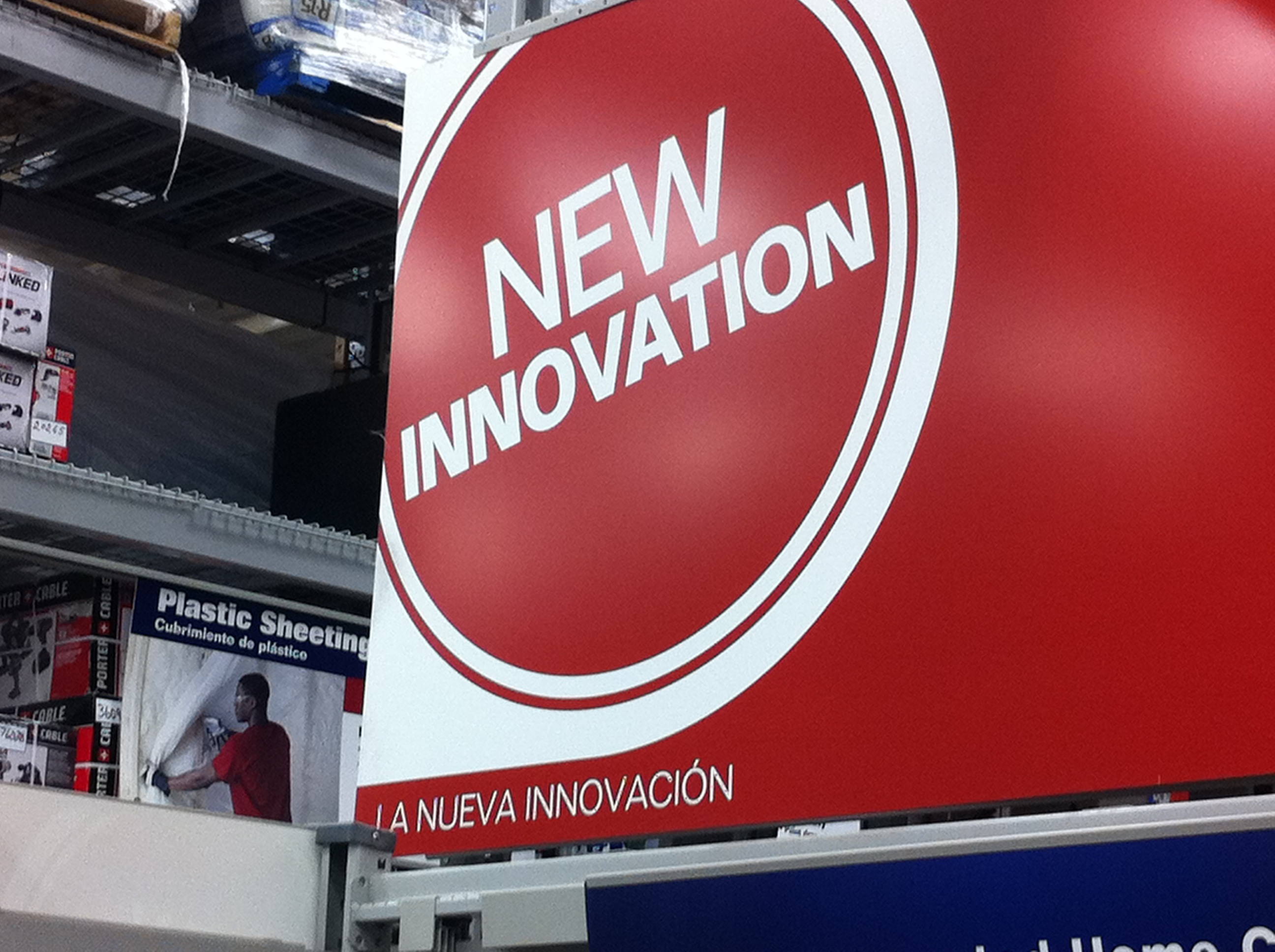
Lowe'sThis past weekend, I made a routine shopping trip to Lowe’s. Strolling around the store, I was stunned to see a large poster marking the entry to one of the aisles: New Innovation. My first reaction was that this was a mistake and that the two words belonged to two different writings. But no, below the “New Innovation” in English, there was a version of the same in Spanish: La Nuova Innovacion. Unable to restrain my curiosity, I walked down this particular aisle trying to find any goods deserving such an ambitious description. I found nothing: the aisle was full of the usual stuff–mostly plywood–that I’ve seen there before (unless, of course, I missed some new and highly innovative sizes).

For a split second, I entertained an idea to approach the Lowe’s personnel and ask them what exactly “new innovation” means. And, perhaps, inquire whether they’re going to create a section “Innovation on Sale.” Then, for the reasons anyone can understand, I rejected this idea.

Are we going crazy about using the word “innovation”? I already wrote that innovation has become a buzzword, with inevitable dilution of its original meaning and unfortunate attempts to use it to describe something innovation is not. I can understand the desire of the Lowe’s management to impress visitors of their stores with catchy slogans. Yet, by doing this in such a silly way, they mislead not only them but they own employees as well.  Either way, this is a huge disservice to the Lowe’s brand.

No, I don’t call for a word police; nor do I see any sense in having one. I do however expect marketing professionals working for retail sector understand the meaning of words they’re using. And I really expect them paying respect to innovation–as an innovation manager and as a consumer.

Posted in Innovation | Tagged , , | 1 Comment