The Merriam-Webster Dictionary defines “consultant” as a “one who consults another.”
How true! As someone who’s been in the consulting business for many years — as a consultant and also as a consumer of consulting services — let me assure you that this is exactly what consultants do: they share their knowledge and experience with other people.
This knowledge and experience can take different forms and in the picture below, I attempted to summarize the roles that consultants may play in the corporate innovation process:
One can wonder perhaps: consultants are usually outsiders who often have a poor knowledge of what’s going on inside the firm. How can they teach insiders?
First of all, as the great Sherlock Holmes once said, “If you have all the details of a thousand [misdeeds] at your fingertips, it is odd if you can’t unravel the thousand and first.” Experienced consultants have seen enough different troubles in other firms — and how these troubles were resolved — that they almost always can suggest a right solution to this particular problem in this particular firm.
Besides, they have a certain edge over the insiders: consultants are not exposed to the often-toxic fumes of internal politics. This helps them better deal with competing ideas and opinions, judging them on their merits rather than their authorship.
And then, there is this ability to be a “stranger in the room,” a luxury of not knowing the ways things “have always been done here” — and being naïve enough to keep asking stubborn “why’s” when everyone else in the room already knows the “right” answer.
I appreciated the magic power of a “naïve” question a few years ago after having a meeting with a client, a pharmaceutical company.
As often happens, the meeting was organized in haste, and the only thing I was told was that the client wanted to discuss the issue of phosphorus-containing detergents. I thought I knew what that meant. This pharmaceutical company used phosphorus-containing detergents to clean production vessels after each manufacturing cycle. But phosphorus-containing compounds, notoriously environmentally unfriendly, had been steadily falling under regulatory scrutiny; it was only a matter of time before the regulatory authority, the U.S. Food and Drug Administration, would ban using them altogether.
I knew from my previous interactions with this client that they wanted to act proactively and switch to detergents based on more environmentally safe organic acids, as some of their competitors had already done. Having assumed that the client wanted to crowdsource the optimal composition of a new cleaning solution, I spent my flight time reading relevant articles I managed to print out before rushing to the airport.
The next morning, I was sitting in a room with five managers responsible for cleaning the manufacturing equipment. A nice breakfast was served, and, judging from my prior visits, a delicious lunch was to follow by noon.
After a few minutes of discussing the latest football scores, I got down to business: “Okay guys, do you want to identify the best phosphorus-free cleaners?”
“No,” responded the gentleman in charge of the meeting on the client side, “there are plenty of commercially available cleaners based on citric acid. We know precisely what we want to use.”
I felt a bit puzzled: “So, what is the problem?”
“The problem is that there is a strong resistance inside the manufacturing unit to switching from a phosphorus-containing cleaner to the one based on citric acid. We tried, but it didn’t work.”
Feeling even more puzzled, I asked: “Who in the company has the authority to make this decision? Have you talked to this person?”
By the silence that followed, I realized that I had said something absolutely horrible. Completely unwillingly, I had put my hosts in an awkward situation: They should have felt embarrassed that such a simple — obvious even to a stranger — solution had somehow escaped their attention.
The managers exchanged uneasy glances, and the one in charge uttered: “Well, we don’t actually know…”
Another manager intervened to help: “We’ll find out and bring this issue to the table. Perhaps, the situation isn’t as bad as it appears…”
Barely in its fifteenth minute, our four-hour-long meeting was over. We chatted a bit more, discussing potential next steps, but I already knew that this team would never contact me again. (I was correct.) Apparently mindful of the fact that I was deprived of lunch, my hosts paid for my cab to the airport.
I managed to change my mid-afternoon flight for an earlier one and my watch was telling me that I would be home well before dinner. I sat in a half-empty airport terminal lit with the bright morning sun and sipped coffee from the nearby Starbucks.
A few things. First, an army equipped with modern weapons and instilled with high spirit. Second, a vibrant economy capable of sustaining the hardship of continued military operations. Third, strong public support for the country’s political and military leadership.
Anything else I forgot to mention? Ah, one more thing: you need an enemy. And not just an enemy, a bogeyman you’ve created to justify the war, but the enemy, the real cause of your troubles that needs to be conquered.
The War on Everything
Finding the true enemy is usually, though not always, easier in case of military operations. But we Americans love to launch “wars” against everything we consider a threat to our society. That’s where defining the enemy may become tricky.
Take President Johnson’s 1964 War on Poverty. By failing to identify the root causes of poverty, the federal government has since been shelling the elusive enemy with 92(!) federal programs. According to a 2016 study, it had spent $668 billion on anti-poverty programs; state governments had contributed another $284 billion. The result? The poverty rate in the U.S. has been steady over the past 50 years, fluctuating between 11 and 15% (11.5% in 2022).
Or take the War on Drugs launched by President Nixon in 1971. Since its start, the initiative has received over $1 trillion in funding. However, by focusing on fighting drug traffickers instead of treating drug addicts, the War on Drugs has miserably failed to eradicate illegal drug use.
The only arguably bright spot in our fight against social maladies has been President Nixon’s War on Cancer. By identifying molecular targets responsible for malignant growth and then designing drugs specifically attacking these targets, scientists have been able to dramatically decrease the death rate for many types of cancers. The total cancer death rate in the United States fell 25% from its peak in 1991.
The 80:20 Rule
I’m not a fan of using military terminology for non-military topics. Yet, it’s tempting to compare a problem-solving campaign to a military operation. Of course, you need a competent group of problem solvers (your “army”) to solve a problem. But even more important is to correctly define this problem (your “enemy”) so that it could be attacked in the most efficient way. Failing to do so will make your enemy elusive and your campaign unfocused and ultimately unsuccessful.
I call it the 80:20 rule: in my experience, about 80% of unsuccessful problem-solving campaigns fail because the problem presented to the group of solvers was not properly defined; only 20% do so because of a poor match between the problem and the solvers.
Defining problems isn’t easy, but it can be learned. Unfortunately, many firms, especially new to innovation, don’t understand the importance of this process. They mistakenly believe that they can ask their problem solvers almost anything, in any form, and then it will be up to the solvers to figure out what needs to be done. This is the wrong approach, and that’s why having around someone with experience could help.
What Is Your Endpoint?
I remember a project I had with a client, a large pharmaceutical company. My client wanted to design a high throughput screening (HTS) assay to study a specific type of cellular transformation, a process by which normal cells become cancerous.
(To those unfamiliar with HTS assays, I will say that pharmaceutical companies routinely use them for drug discovery because HTS assays allow researchers to screen tens or even hundreds of thousands of chemical compounds for biologic activity. Although HTS assays employ robotics and sophisticated software, at their core they are still a “regular” assay: you start with a normal cell, you add a test compound, and you watch for something that indicates that the malignant transformation you’re interested in has taken place.)
My counterpart on the client site, the head of the assay development group, confidently listed the most important parameters the future assay was expected to have: the volume (the number of samples analyzed per hour or day), the percentages of false positives and false negatives (the two key parameters defining the assay accuracy), and the cost (as cheap as possible. (But of course.)).
Listening to her and taking notes, I began sensing that something important was missing. Finally, I interrupted: “All right, everything is clear. But what about the endpoint? What is your endpoint?” (In a typical assay, the endpoint is what the assay measures).
For a split second, my interlocutor lost her confidence. She paused and then said slowly: “Well, we do not have an endpoint. We thought that finding it would be part of the whole solution.”
It was my turn to pause before replying. “Well, perhaps we’re asking too much. What if we start with looking for a suitable endpoint and then, after we found one, we run a follow-up project to design an HTS assay based on this endpoint?”
She broadly smiled in response: “Look, if we had a good endpoint, we wouldn’t need you: my in-house developers will design an HTS version of the assay in a matter of weeks.”
This was a turning point of our conversation. Shortly, the two of us put together a problem statement asking for a molecule whose change in structure or quantity within cells would signal that the cellular transformation in question took place.
We posted the statement online, and in a couple weeks, I got a submission from a university professor living in one of the small Eastern European countries. The submission described a protein (I’d never heard of it before) that was overproduced by the cells that had experienced the transformation my client was interested in. This overproduction could be easily detected by measuring the intensity of fluorescence, a slam dunk for any assay developer.
Frugally written, barely a page in length, the submission had a few paragraphs of text, a picture, and a reference. But it was nevertheless something I could share with my client. Her response followed almost immediately: “I love it! We’re buying this solution.”
And that was it. I completed the paperwork transferring the solution to my client in exchange for a money award. I never heard from her again: apparently, her in-house assay developers were indeed as good as she described them.
Know what you want, understand what you need
Clients always come to me knowing what they want. Unfortunately, quite often, they don’t clearly understand what they need.
I remember a client who wanted to change the design of a paint pump because it clogged when dispersing paint. We investigated the problem at some depth and found that the cause of clogging was not the pump. The clogging occurred because the paint was rapidly becoming viscous with a slight decrease of the surrounding temperature. The client fixed the clogging problem by simply changing the composition of the paint.
I remember another client who wanted to find an additive that would prevent a food product from losing sweetness upon manufacturing. It took me some effort to persuade the client to leave the door open for solutions that would include modifications of the food preparation process itself. “No, we can’t change the process; it’s too expensive!” he kept saying. To my client’s great surprise, someone came up with a solution proposing a minor, inexpensive change in the preparation process that led to the same desired result: the preservation of sweetness.
It’s tempting to say that what clients want is often just a symptom of a disease whereas what clients need is the cause of it. You can’t successfully cure the disease (solve the problem) unless you identify its real cause (define the problem).
But enough playing with words! Let me simply formulate my “golden” rule of problem solving: know what you want, understand what you need.
There are two major reasons for the slow adoption of crowdsourcing as a practical problem-solving tool.
The first is a widespread, often completely paralyzing uncertainty over which problem crowdsourcing can (or can’t) solve.
The second is the lack of trust in the intellectual power of the crowd, its ability to tackle complex technical or business problems. Everyone would seem to agree that the proverbial wisdom of crowds can be applied to a “simple” task, such as creating a corporate logo or coming up with a fancy name for yet another Frappuccino du jour. However, when it comes to answering a question that requires specialized knowledge, firms prefer to turn to experts.
“Crowds of Amateurs”
This preference obviously sits well with the experts themselves. They dislike the very idea that someone with no immediate experience in the field can solve a problem that they failed to. This sentiment was eloquently summarized in a 2010 article: “Our trust in the expert appears to be increasingly supplanted by a willingness to rely on the knowledge derived from crowds of amateurs.”
“Crowds of amateurs.” Harsh words, huh?
Pitting experts against crowds is plain silly. Experts represent an essential part of any problem-solving process; in fact, this process is impossible without experts. Only experts can identify and properly formulate problems that need to be solved. Only experts can assess the value of incoming solutions and select those that make sense. Only experts can successfully integrate external information into the knowledge available in-house. It’s only at this midpoint of a problem-solving campaign — at the stage of generating potential solutions to the problem — that crowds are usually superior to experts.
What Does It Means to Be an Expert (in Mice)?
Why are crowds usually more creative than experts? A 2019 neurobiological study may provide a clue. A research team from Cold Spring Harbor Laboratory has set out to analyze neuronal activity in the brains of mice forced to learn new decision-making skills.
As the mice progressed through learning new tricks, more and more neurons in their brains got activated. However, the neuron activity rapidly became very selective:individual neurons responded only when the mice made one choice and not another. This pattern became even stronger as the mice learned how to do a task better (that is, become “experts” in this task). Moreover, when the expertise was fully achieved, the mouse brain was ready for that decision even before the mouse began executing the task.
In other words, the “expert” mice knew how to solve the problem even before they started to solve it! In contrast, the neuronal activities in the brains of “non-expert” mice remain non-selective — meaning that the mice would approach the task with an “open mind.”
Were these findings directly applicable to humans, the implication would be that experts approach the problem with the patterns that are already pre-formed in their brains by prior experience. In contrast, amateurs may approach the problem from a completely different angle — and the more amateurs are involved in solving the problem, the more chance that a completely novel, unorthodox solution could be found.
Does Practice Make You Better at Solving Problems? It Should. But It Doesn’t
I’m usually among the first to argue that discoveries made in mice may have little relevance to humans. Examples of clinical trials in which a drug that was effective in mice would flop spectacularly in humans are so numerous that they could fill a warehouse as big as N.Y. Grand Station.
And yet, some indications that expertise may come at the expense of lost creativity in humans have emerged too.
A research team at Stanford conducted a study of how repetitions — that is, continued efforts over time — affected two types of creativity: divergent and convergent thinking. Divergent thinking is the kind of thinking process that involves branching off from what a person knows to come up with new ideas; it’s divergent thinking that is utilized in idea-generating sessions. In contrast, convergent thinking requires finding linkage between different existing concepts or ideas and connecting them to context; it’s convergent thinking that is usually associated with expertise.
What the researchers found was that regular brainstorming sessions didn’t improve the efficiency of divergent thinking: not only test subjects didn’t generate more unique ideas over time; the novelty of these ideas — a measurement of a degree to which test subjects’ inspiration departs from convention — actually decreased over time.
At the same time, test subjects charged with convergent creativity tasks were getting better and better over time, increasing their productivity while performing the task.
It appears that practice improves performance by reinforcing certain cognitive pathways in the brain, making them more accessible, but, at the same time, de-emphasizing other pathways, cutting them off in order to allocate an optimal amount of cognitive resources to the prioritized task. In other words, by training the brain to become more efficient and focused, the repetition also results in a less flexible brain.
(The authors of the Stanford study didn’t perform analysis of the neuronal activity in the brains of their text subject, but I suspect they would have revealed the same pattern of activation and selection that was shown in mice.)
The Last Word
I can only repeat: It’s plain silly to pit experts against crowds. Moreover, there is even no sense in discussing which tool, experts or crowds, is better. Both are different, complementary tools in the modern innovation toolbox, and each should be used at its proper time and place.
As a rule of thumb, when solving a problem similar to one that the firm faced in the past, the firm should engage experts. However, if the problem is novel and may require a fresh look at it, engaging crowds would be a better choice.
What is the effect of government regulations on innovation?
The most comprehensive answer to this question is: It depends. It can be positive. In a recent article, I present evidence that corporate innovation can be fostered by social liberalization policies and by laws that limit firms’ ability to discharge employees at will.
We also have a shining example of a government regulation that had a profound negative effect on innovation: Prohibition of 1920–1933, a nationwide ban on the sale of alcoholic beverages. In a brilliant 2020 paper, “Bar Talk: Informal Social Interactions, Alcohol Prohibition, and Invention,” Michael Andrews provides a detailed description of what happened when a government action had disrupted the established pattern of people-to-people interactions.
Prohibition and patenting
Before the passage of federal prohibition, U.S. states and counties could determine for themselves whether or not to allow alcohol consumption in bars and saloons. When federal prohibition went into effect, counties that were previously wet saw an 8–18% drop in patenting relative to consistently dry counties in the same state.
As a former researcher, I admire the rigorous checks Andrews applies to prove that the observed effects were caused by preventing people from going to bars rather than by other factors. For example, he shows that the drop in patenting was smaller for groups that did not typically attend saloons, such as women and ethnic groups that preferred to drink in private.
More importantly, Andrews presents evidence that prohibition did not appreciably reduce the total alcohol consumption in newly dry counties. (I’m not surprised. Are you?) And this leads Andrew to his main point: the negative effect of prohibition on invention was caused not by preventing people from drinking alcohol, but by disrupting natural social networks.
Prohibition and disrupted networks
Prohibition presents a particularly attractive model to study the role of social networks in innovation. Prior to prohibition, bars and saloons acted as social hubs in which individuals could exchange information in an informal setting. Prohibition is so useful to studying the effects of social interactions on innovation because it disrupted the structure of social networks but didn’t change its scale or the identities of the individuals within the network.
One of the study findings seems to carry special weight. If networks facilitated invention by simply making it easier for individuals to find collaborators, then only patents with multiple inventors would have declined. Instead, Andrews found that solo-inventor patents declined as well. That means that networks not only bring people together but also let them exchange ideas between them.
And let’s not forget: moderate alcohol consumption may have a stimulating effect on human creativity. Bars and saloons not only bring people together—in a way religious services or charity events would also do — and let them exchange ideas; by serving alcohol they may improve the quality of ideas that are being exchanged.
COVID-19 and innovation
Andrews’s study is especially relevant when we consider the massive disruption of global innovation networks caused by the COVID-19 pandemic. Like prohibition, the pandemic did not change the scale or the identity of the individuals within the network. But by massive shifting to remote work (to “drinking from home,” so to speak), it disrupted informal interactions. Now, we can only guess what the long-term consequences of this disruption will be.
In this context, one more Andrew’s finding deserves attention. While patenting fell dramatically in the years immediately after the prohibition onset, it rebounded over time, meaning that affected individuals gradually rebuilt their informal social networks.
What is interesting, however, is that when people began rebuilding their social networks after prohibition, they did not collaborate with the same individuals as they did in the past. Instead, they connected with new people, which apparently led to their exposure to different ideas. This was manifested in a long-lasting change in the types of inventions these individuals filed, as measured by patent classes. In other words, while the rate of innovation will restore over time following disruption, the direction of innovation may change.
And that means that the post-COVID innovation may turn out to be different. Will we like it more? Less?
Innovation and the “return-to-office” policy
Recently, we’ve been seeing increasing attempts by firms to change the established pattern of remote work and bring employees back to office — all under the banner of caring about communication and collaboration.
Theoretically, innovation too will gain from employees returning to office. Experts warn that online communication, a hallmark of remote work, is characterized by lower information sharing. That leads to reduced exchange of ideas between innovators, the major cause for the prohibition-induced patenting slump. From this vantage point, the “return-to-office” policy can be viewed as an attempt, conscious or not, at rebuilding corporate innovation networks damaged by remote work — and bringing them as close as possible to the structure that existed before the pandemic.
Unfortunately, this pattern of restoring corporate innovation networks — “forceful” is the word that comes to mind — carries a risk. By and large, corporate employees are unhappy with the mandatory return to offices. According to a survey conducted by Clarify Capital, 68% of employees said they would rather look for a new job than return to the office.
I’d like to remind my readers that freedom is a powerful driving force of innovation. Yes, you can force people back to their offices and make them communicate in person. But will these unhappy people freely exchange creative ideas with other unhappy people? I have my doubts. It’s like bringing a nondrinker to a bar and expecting them to have fun while chatting with a bunch of other nondrinkers.
I think a better way to restore productive collaboration between members of innovation teams would be bringing them to regular off-site meetings. Placing employees in enjoyable settings — with ample time for physical activity and relaxation — will generate conditions for a free and unrushed flow of ideas between the participants. Sooner or later, something innovative will emerge.
Should alcohol be served during these events? Why not, if all the participants are above 21?
In a previous article, I argued that the widespread belief that we are swimming in an ocean of cheap innovative ideas — embodied in a popular line “ideas are a dime a dozen” — is no more than a myth. Available evidence shows that the U.S. is facing a growing shortage of novel ideas. Worse, the cost of getting these ideas is increasing while their quality seems to be declining.
What’s going on?
One thing is clear: the quantity and quality of novel ideas are declining because sources of new scientific discoveries are drying up. Although total U.S. spending on R&D reached a reputable 3.4% of GDP in 2021, only about 20% of the money came from the federal government, down from 50% in 1970; 70% of it was contributed by the private sector. With its focus on rapid returns, will the private sector fund fundamental and therefore risky R&D projects? No. (Of note, 75% of U.S. venture capital goes to software development and another 5–10% to biotech. How is the rest of R&D supposed to be funded?). The industry might still be capable of generating incrementally innovative combinations of old ideas — which indeed can be plentiful and cheap — but it is unlikely to create breakthrough innovations.
I think we must also consider another explanation: we have become less creative as a nation.
This fanciful — and, I suspect, offensive to many — idea came to me after reading a 2017 article in Wired. The article described a study showing that bored individuals generated more creative ideas than a non-bored control group. The authors of the study argued that boredom might spark creativity because a bored mind craves for stimulation.
Our problem is that the proliferation of social media channels has all but eliminated this “bored” state of mind. We are always so busy playing with mobile devices that our brains get numbed with the constant flow of mostly useless input. Being constantly “on,” our mind refuses to get positively stimulated — and by refusing to stay bored, we become less creative.
What can we do to generate new sources of innovative ideas? First of all, we need to restore public R&D spending to the levels that ensured the U.S. domination in innovation in the past. This path is clear, although it will still take time to repair the damage caused by decades of neglect.
But can we address the problem from another angle? Can we become more creative to dramatically improve the quantity and quality of new ideas? What do we know about ways to stimulate human creativity?
Innovating in a Dream
There are a few reported approaches to boosting human creativity.
Some of them are very proper. (Perhaps the most popular is taking a shower — especially if followed by going to the garden and sitting under the apple tree. But jokes aside.) One of them is practicing mindfulness meditation, an activity 10–12 minutes of which was reported to help generate higher-quality business ideas. Google, Goldman Sachs, and Medtronic are said to have introduced meditation and other mindfulness practices to their employees.
Another, conceptually similar way to boost creativity is an interrupted nap. When people are just beginning to fall asleep, they go through the so-called non rapid eye movement sleep stage 1 (or N1), often described as “the twilight zone between sleep and wakefulness.” A group of French researchers showed that spending at least 15 seconds in N1 — and then being awakened — boosted creativity of test subjects: they were significantly more likely to find a creative solution to a math problem compared to the test subjects who proceeded past N1 without awakening or those who didn’t fall to sleep at all.
I strongly suspect that the positive effect of mindfulness meditation is realized through the same, N1-dependent mechanism. (“At some moment, your mind will naturally wander away,” is how an instruction to practicing mindfulness meditation describes this magic point.)
I’m in no rush
Other creativity-stimulating activities may carry a stigma with them. For example, it was reported that procrastination may lead to higher creativity ratings in test subjects. The relationship between procrastination and creativity seems to be inversely U-shaped (yet another example of the “inverted-U law of life”): test subjects who procrastinated moderately received higher creativity ratings than those who procrastinate less or more. The authors of the study speculate that moderate procrastination sets in motion a mechanism of problem restructuring, which results in the production of more creative ideas.
Sounds promising, but let’s admit it: procrastination is frowned upon in the marketplace. Procrastinating people are considered inefficient, unproductive, and, even worse, bad team players.
As a devoted procrastinator myself, I’ll defend procrastination. I’ll point to statistical data showing that the U.S. is the most overworked developed nation in the world. The average productivity of an American worker has increased 400% since 1950; yet we’re working the same 40-hour workweek, at least on paper. Don’t we have a right to treat our brain to an occasional spell of quiet, unrushed deliberation, especially if rewarded for that with a shot of creativity?
Innovating With a Drink
And if you think that procrastination is a questionable way to boost creativity, you’re likely to dislike the next approach. But here we go: a research team at the Mississippi State University led by Prof. Andrew Jarosz treated a group of men ages 21 to 30 to vodka/cranberry juice in three drinks over a 30-minute period until their blood alcohol level reached near legal intoxication point of 0.075. The researchers then gave the test subjects a series of word association problems to solve. The result? Tipsy subjects solved 13% to 20% more problems — and did it faster–than sober subjects in the control group.
Prof. Jarosz hypothesizes that people under the influence are more susceptible to the so-called mind wandering, which results in losing some focus but gaining the ability to see a “bigger picture.” This effect, of course, can be harmful in many situations requiring concentration but it might be helpful in others where the ability to connect the proverbial dots is more important than focusing on a single dot.
Regretfully, there is a discernible pause in the academic research on chemically induced ways to influence human creativity. For example, a 2017 study attempted to systematically review all published (by that time) articles that focused on the relationship between psychoactive substances and creativity/creative artistic process. A total of only 19 studies were identified that met inclusion criteria. Little surprise that the results were difficult to summarize because of different study designs, diverse methods used, and various substances examined. A conclusion of the review, nevertheless, was that an association between creativity and substance use did exist. (Of note, a recent study found that light doses of cannabis, while increasing mood and joviality of test subjects, didn’t make them more creative in standard creativity tests.)
That’s why I like Prof. Jarosz and his colleagues’ study: in contrast to many narcotics or drugs, ethyl alcohol is a simple chemical molecule, whose behavior in the human body is quite well understood. Using this relatively simple model, researchers may start identifying specific neurochemical reactions in the brain that are responsible for creativity.
The Power of the Wandering Mind
It appears that the very first steps in this direction have been already made.
It is widely accepted that the creative process proceeds through four distinct stages:
Preparation. At this stage, your brain is gathering information.
Incubation. It is at this stage that you let your mind wander around.
Illumination. This is a “eureka!” moment. Connections in your brain collide, and you realize that you got an idea.
Verification. Your critical thinking skills return at this stage, and you start “packaging” your newly born idea in a consumable way.
Back in 2011, Torsten Norlander of Karlstad University in Sweden showed that alcohol consumption specifically stimulated the incubation and illumination stages of the creative process but inhibited both the preparation and verification stages. And this seems to be exactly what Prof. Jarosz’s team has observed: intoxicated individuals who solved more creative problems in less time than the control group perceived their solutions as the result of a sudden insight. Eureka, in other words.
It also appears to me that the power of the wandering mind — unleashed as a result of interrupted nap, mindfulness meditation, or alcohol consumption — is realized through the same N1-dependent mechanism.
The good news is that we already know the parts of the human brain responsible for N1 sleep and we began identifying brain networks promoting the transition from wakefulness to sleep. That means that it’s only a matter of time that we pin down the sections of the brain responsible for creativity — along with safe and efficient ways to stimulate them on demand.
And we all will have a choice of how we prefer to innovate: in our sleep or with a drink.
The following are twelve thoughts about crowdsourcing taken from my recently published book “We the People of the Crowd…” and summarizing my 20+ years of experience in running internal and external crowdsourcing campaigns.
In recent years, crowdsourcing has become a popular topic in business publications and social media. Yet its acceptance as a practical problem-solving tool has been slow. Why? First, there is a widespread, often completely paralyzing, uncertainty over which problem crowdsourcing can (or can’t) solve. Second, the expansive use of the term “crowdsourcing” has blurred its borders with other problem-solving tools. As a result, crowdsourcing is often used incorrectly, and when the outcome disappoints, it is crowdsourcing itself that gets the blame for being ineffective.
A fundamental benefit of using crowdsourcing is that by posting your problem online, you become agnostic to the sources of potential solutions. They may come from anywhere and anyone, and you don’t have to do anything to “target” your search — given, of course, that your crowd is sufficiently large and diversified. In other words, when you crowdsource, you don’t have to spend time and resources on finding solvers to your problem; you only need to analyze the solutions that these self-selected solvers are sending your way. Let me repeat it again: the beauty of crowdsourcing is that you don’t need to look for solutions to your problem. You post your problem online, and then the right solution will come to you.
When working with subject-matter experts, be aware of the issue of diversity of responses. If you’re approaching a person who is an expert in Method A, don’t expect this person to tell you that using Method B might be a better solution. And if you’re approaching an expert in Method B, don’t expect them to tell you that this method won’t work; a solution provided by this expert will inevitably include at least some of Method B. Besides, there is always a chance that Methods C, D, or E exist, but because you never heard of them, you don’t know appropriate experts. Saying it differently, when asking for an expert opinion, you automatically narrow the scope of potential solutions to what you already know. Crowdsourcing is different. Unless you specifically say that you’re interested only in Methods A or B, incoming solutions will be focused on solving your problem, not the way of solving it. That’s why a properly designed crowdsourcing campaign often results in highly original, even completely unexpected, solutions forcing your clients to exclaim in awe, “Wow, we never thought about that!”
Yet another reason for the slow adoption of crowdsourcing is the lack of trust in the intellectual power of a crowd. Sure, it’s OK to apply the proverbial “wisdom of crowds” to accomplish a simple task, such as creating a corporate logo or choosing the name for a city landmark. However, when it comes to answering questions that require specialized knowledge, corporations prefer to turn to experts. A fundamental flaw of the notion that people participating in crowdsourcing campaigns are just a bunch of “amateurs” is that real-life crowds are composed of experts. True, they might not be experts working in your field or in your industry; but they’re experts in something, nonetheless. Moreover, research shows that someone’s likelihood of solving a specific problem increases with the distance between this person’s own field of technical expertise and the problem’s domain. Crowdsourcing folklore is full of stories featuring a patent attorney cracking chemical synthesis problems in his spare time, or a protein crystallographer who solved a toxicology mystery that puzzled a bunch of seasoned toxicologists.
When pointing to the virtues of crowdsourcing, I’m not trying to pit experts against “crowds.” Crowdsourcing is impossible without experts. Only experts can identify and properly formulate problems that organizations are facing. Only experts can understand and evaluate external proposals to select those that make sense. Only experts can combine external information with the knowledge available in-house. It’s only at this midpoint of the problem-solving process — at the stage of generating solutions to the problem — that crowds are usually superior to experts. We, therefore, should consider experts and crowds as complementary tools in every innovation management toolbox. There is no sense to discuss which tool is better; each should be used at its proper place and time.
Crowdsourcing is first and foremost a question, a question that you ask a crowd of contributors. It doesn’t matter what this question is about, if it’s well thought out, properly defined, and clearly articulated. Yes, it can be a question about a solution to a problem. And yes, it can be a question about the problem itself. So, when asked what one needs to run a successful crowdsourcing campaign I always answer: only two things. A question and a crowd.
I’m not a big fan of using military terminology for non-military topics. Yet, it’s tempting to compare a crowdsourcing campaign to a military operation. To begin with, you need a large and competent crowd (your “army”) to solve a problem. But even more importantly, you must define this problem (your “enemy”) so that the crowd can attack it in the most efficient way. Failing to do so will make your enemy elusive and your campaign unfocused and, inevitably, unsuccessful. I call it the “80:20 rule”: in my experience, about 80% of unsuccessful crowdsourcing campaigns failed because the problem presented to the crowd was not properly defined; only 20% failed because of a poor match between the problem and the crowd’s skillset.
Crowdsourcing is often confused with brainstorming but there is a principal difference between the two. When you brainstorm, you put a question to a few people and let them come up with answers. As the brainstorming session progresses, people propose their own ideas, capitalize on the ideas of others, or perhaps redefine the question itself. Many people believe that if you replace this group of four to seven — reportedly the optimal number of people for brainstorming — with a crowd of dozens or even hundreds and move this discussion online, you’ll get crowdsourcing. But this is not true. Crowdsourcing is different from brainstorming in one crucial aspect: it requires the independence of opinions. In contrast to brainstorming, during a crowdsourcing campaign, you must make sure that the members of your crowd, whether individuals or small teams, provide their input independently of the opinions of others. It’s this aspect of crowdsourcing that allows avoiding groupthink and other cognitive biases and leads to the delivery of highly diversified, original, and often completely unexpected solutions to the problem — as opposed to brainstorming, which almost always ends up with the group reaching a consensus.
Online communities give us many diverse options to interact with other people. Every option is a tool of sorts, and as any tool, it should be used with a full understanding of what it can or can’t do. Among other tools, crowdsourcing stands out by being, first and foremost, a question that you ask a crowd. The quality of the question is the most crucial factor in determining the quality of the answer. You ask the crowd a smart question — you have the chance to get a smart answer. You ask the crowd a stupid question — the answer will almost certainly be stupid. It’s this simple.
It’s difficult to precisely define how many people one should bring together to have a “crowd.” However, from the practical point of view, this number isn’t vitally important. I used to work with relatively small crowds, no more than just a few dozen people, that nevertheless successfully solved difficult problems. The opposite is also true: a crowd composed of more than a hundred thousand may well fail to deliver a good solution. Much more important than the crowd size is its diversity. If I had to choose between a crowd composed of ten thousand military officers — or ten thousand lawyers, or ten thousand farmers — and a crowd of only one thousand that included military officers AND lawyers AND farmers, I would choose the latter. And if offered the opportunity to work with a crowd of a million, I would not even bother to ask about the crowd’s composition. I know that by virtue of its sheer size, such a crowd will include people of different professional, educational, cultural, and cognitive backgrounds — in other words, everyone to make up an “ideal” crowd.
Unfortunately, many organizations begin launching external crowdsourcing campaigns before engaging internal crowds. The results are often disappointing: lacking internal support, external ideas and solutions are often met with stiff resistance from inside the company. Their implementation gets stalled, then tacitly boycotted, and eventually rejected. To add insult to injury, such outcomes give additional ammunition to naysayers, who jump at the opportunity to claim that “crowdsourcing doesn’t work for us.” This is not to say, of course, that organizations should postpone experimenting with external crowdsourcing until they master the art and science of internal (which may take years). My point is that the full potential of external crowdsourcing for any organization will only be realized by the concerted effort of connected employees capable of identifying and defining their own needs. Or, to say it differently, the power of crowdsourcing comes from the strength within.
A few years ago, a group of New York City-based entrepreneurs proposed an interesting version of crowdfunding, crowdraising, an approach that allows crowds to pledge time instead of money to support projects and causes they care about. Any organization with a worthy goal would be capable of using crowdraising to hire a crowd to perform business-related activities. These activities could be as simple as taking part in a survey, conducting beta testing, or giving feedback. But they could also involve more complex tasks, such as coding, design work, or strategic advice. After completing their work on the project, the members of the crowd would be expected to be rewarded: from a free product sample for simpler tasks to cash or equity for more complex activities. As far as I know, this approach hasn’t yet been realized in practice. However, I consider crowdraising a promising idea with the potential to create a new paradigm of finding and hiring employees in the gig economy. Taken together with new ways of problem-solving (provided by crowdsourcing) and raising money (provided by crowdfunding), all three approaches may profoundly shape the future of work. And there is something else I strongly believe in: new ways of capitalizing on the wisdom of crowds will emerge.
With giant waves of technological change rocking every corner of the global economy, innovation isn’t a luxury anymore, not even a matter of choice; it’s a means of survival. The mantra “innovate or die” may sound like a cliché, yet it correctly reflects the contemporary business environment, in which companies must relentlessly innovate to just stay in business.
Unfortunately, managing the innovation process in a sustainable way turned out to be difficult for a lot of organizations. Many of them have failed to establish the structure and processes needed to run effective innovation programs and instead are wasting time on chasing the elusive “culture of innovation.”
To be sure, it’s impossible to deny the importance of the human component in any business process, including innovation. But it’s much more important to design and implement actionable corporate policies that boost innovation. There is no need to start from scratch: specific socio-economic factors affecting innovation have long been described in the literature.
When analyzing these factors, I came to a somewhat unexpected conclusion: one of the most powerful drivers of innovation — and the one that draws surprisingly little attention — is freedom. Yes, freedom. Freedom emerges as a common denominator for the factors that boost innovation. The reverse is also true: restrictions on liberties have a chilling effect on the corporate innovation process.
In this article, I’ll present evidence showing that freedom has a positive effect on innovation. I’ll also show that this effect manifests at three major levels: individual, organizational, and national.
Freedom of being yourself
I suspect not many people have heard about employment nondiscrimination acts (ENDAs). ENDAs are US state-level laws that prohibit discrimination based on sexual orientation and gender identity. A 2016 study showed that firms located in US states that have passed ENDAs obtained more patents, a popular measure of innovation, than firms in US states without ENDAs. The result was more pronounced for the firms in human capital-intensive industries, such as technology and finance, and, unsurprisingly, in the states with a large LGBTQ+ population.
Another study, published in 2018, used the same innovation metric, the state-level patenting, to study the effect of two social liberalization policies: the legalization of medical marijuana and same-sex marriages. The study showed that the adoption of these two policies increased state-level patenting. In contrast, the laws imposing restrictions on abortion had a negative effect on innovation in the states that adopted anti-abortion legislation.
I’m not aware of any data indicating that people smoking weed or belonging to LGBTQ+ communities are intrinsically more innovative. Instead, I argue that innovation requires a certain level of individual freedom, including freedom from being discriminated against for whatever reason.
This point echoes the results of a 2015 study describing team building at Google, one of the world’s most innovative companies. The study listed five key factors that set successful Google teams apart; the most important factor of the five was psychological safety, the ability of team members to take risks without feeling insecure or embarrassed.
Given the above findings, what actionable measures can companies undertake? The answer is simple: to energize their diversity, equity, and inclusion (DEI)programs.
The positive effects of diversity on innovation are well documented. Everyone agrees that diverse people bring unique information, perspectives, and experiences — all necessary components of successful innovation. But let’s not overlook another major benefit of a diversified and inclusive marketplace: freedom of being yourself.
Freedom to try and then try again
Economists have long argued that conditions incentivizing employees to innovate must include tolerance for early failures. This allows corporate innovators to take risks at the initial stages of the innovation process — when the rate of unsuccessful experiments is especially high — without facing negative consequences for failed projects.
Available empirical evidence supports this point of view. For example, an analysis of the impact of labor laws on innovation in five countries (the United States, the UK, France, Germany, and India) showed that stronger labor laws — i.e., laws making it more difficult to dismiss workers — positively correlated with a country’s innovation output.
Another study investigated the impact on innovation of the wrongful discharge laws (WDL) in the United States. These laws provide employees with greater protection than employment at will, a common arrangement under which employees can be terminated with or without just cause. The WDL, particularly those that protect employees from termination in bad faith, were found to foster innovation by increasing the employees’ motivation and effort.
These results strongly suggest that corporate innovation is boosted by laws that limit firms’ ability to dismiss employees at will. Experts call this phenomenon an “insurance effect”: feeling increased protection from the negative consequences of failure, employees are more committed to engaging in risky innovative projects.
Companies can capitalize on these findings by modifying their employment policies. For example, they can place employees involved in strategic innovation projects on fixed-term (say, 3-5 years) employment contracts, as opposed to employment at will. Alternatively, the creation of tenure-like job arrangements for the same employees can be considered.
Regardless of specific actions, I insist that providing employees with immunity for failed innovation projects (i.e., giving them the freedom to try and then try again) is a better way to promote innovation than by “celebrating failures.”
It turns out that not only individual innovators, but companies too, enjoy the freedom to fail. This was a conclusion of a 2011 study analyzing the relationship between startups and venture capital (VC) investors. The study examined VCs’ willingness to continue investing in ventures that missed their target milestones. The study showed that startups backed by more failure-tolerant VCs were more innovative, as judged by the number and quality of patents these startups filed. The authors of the study also found that the effect of VC tolerance to failure was much stronger when the failure risk was higher (e.g., in drug discovery) so that VC support was more needed and valued.
Even innovation in large companies benefits from some protection. An analysis of bankruptcy laws in 12 countries showed that more debtor-friendly bankruptcy codes (i.e., codes favoring firms filing for bankruptcy) had a positive effect on corporate innovation. The debtor-friendly laws are thought to encourage firm-level innovation by keeping the firms’ innovative activities alive even at bankruptcy.
Although local labor laws are largely out of corporate control, companies might consider them when choosing the location for their new innovation centers. And startups, of course, have some leeway in choosing VC firms to work with.
Free countries innovate better
The importance of external factors, such as a host country (or a region within a country), on the firm’s ability to innovate has long been recognized. For example, a 2001 study showed that a relatively small number of characteristics of a nation’s business environment explained a striking difference in innovation outputs between developed and emerging economies. The most notable among those characteristics were the overall human and financial resources a country devotes to R&D; public policies relevant to innovation activity (e.g., IP protection and tax-based incentives for innovation); and the country economy’s openness to trade and investment.
However, there is one more level of influence that is almost never considered: the level of a country’s political freedoms.
Take a look, for example, at the 2019 edition of the Global Innovation Index (GII) which ranks the global innovation performance of approximately 130 economies by using a few dozens of indicators.
Even a brief look at the Index leads to a curious observation: the top of the ranking is heavily populated by countries representing established, mature democracies. The reverse was also true: the bottom of the Index is stacked with countries with an abysmal level of democratic development.
To see if this observation had any statistical significance, I plotted the GII rankings against the political freedom rankings provided by the Democracy Index 2020. (The latter index ranks countries on a scale of 0 to 10, marking them as authoritarian regimes, hybrid regimes, flawed democracies, and full democracies). Indeed, a solid correlation (R2 = 0.46) between the two parameters exists indicating that the ability of a country to innovate positively correlates with the level of political freedom in this country. Or, to use a more straightforward language, free countries innovate better.
This finding may have implications for U.S. policymakers when they allocate funds to promote entrepreneurship and innovation abroad. Government officials would be wise to consider the maturity of democratic institutions in recipient countries when anticipating potential returns on innovation investment.
The same is true for domestic spending. Consider the idea to create eight to 10 regional growth centers in the Midwest metro areas of the United States. Central to the idea is the infusion of about $100 billion of federal money over the next 10 years in the form of direct R&D funding, tax and regulatory benefits, and infrastructure support. Concerningly, many of these prospective growth centers are planned to be in the states that have implemented the most restrictive abortion laws (and some other anti-liberal legislation) in the country. Do we expect these centers to become beacons of innovation?
Of course, individual companies may have a limited influence over a country’s level of political freedom. And yet, every company can — and I think should — make its voice heard every time our liberties are in danger be it around the globe or across a state line.
Did you hear that idea generation is the easiest part of the innovation process? I’m sure you did. Generating ideas is easy, many people say; it is at the stage of incubating and scaling these ideas that the innovation engine begins to choke. Taken to extremes, this approach leads to the perception that novel ideas are plentiful and cheap. “Ideas are a dime a dozen.” Are they really?
A joint team of researchers from Stanford and MIT has recently challenged the dogma of “plentiful and cheap ideas.” They presented evidence that research productivity, a scientific term for a layman’s “idea,” is actually declining. According to the authors’ calculations, research productivity across the whole US economy declines at an average rate of 5.3% per year. More specifically, in semiconductors (the playground of the famous Moore’s Law), research productivity is declining at a rate of 6.8% per year; in agribusiness and pharmaceutical research, the annual decline is about 5.0%.
In other words, contrary to popular belief, ideas are not plentiful; we are experiencing a growing shortage of ideas.
If research productivity is on the decline, how then has steady economic growth been sustained? The answer is simple: by raising what economists call research effort, which in plain language means the number of researchers. Indeed, the number of researchers required to achieve the famous doubling, every two years, of the density of computer chips (Moore’s Law) is more than 18 times larger today than it was in the early 1970s.
In some areas of agricultural research, the number of scientists has risen 23-fold between 1969 and 2009. And while research productivity responsible for the drugs approved by the FDA between 1970 and 2015 has been declining at an annual rate of 3.5%, this decline was offset by a 6.0% annual growth in the number of researchers.
Now, let’s do some math. If the number of ideas is declining while the number of people generating them is growing, how can these ideas be cheap? You’re right: they can’t. The ideas are becoming more, not less, expensive.
We can at least hope that the quality of novel ideas remains high. Alas, nothing supports this intellectual refuge. Consider this: by the end of 2019, the venture capital industry had accumulated a whopping $121 billion in so-called “dry powder,” the money for which venture capitalists failed to find ideas to invest in. Plentiful and cheap innovative ideas, where are you!?
Let’s then ask this fundamental question: where do these novel ideas come from in the first place? The answer looks obvious: from R&D, where else?
Exactly, and here is the root of the problem. In the decades that followed World War II, entirely new sectors of the U.S. economy have been created: jet aircraft, modern-day pharmaceuticals, microelectronics, satellites, and digital computers. All these developments happened thanks to a heavy infusion of public money, with the federal government contributing more than 50% of R&D expenses.
Back to our days. Although the total US spending on R&D has remained steady for the past years, at 2.5% of GDP, only about 30% of the money now comes from the federal government; 70% of it is contributed by the private sector. With its focus on rapid ROI and beating competition, will the private sector spend money on fundamental — and therefore inevitably long-term and risky — R&D projects? No.
The quantity and quality of novel ideas are declining because sources of new scientific discoveries in the United States are gradually drying up. Sure, the industry can still generate incrementally innovative combinations of old ideas — which may still be plentiful and cheap — but it will fail to create breakthrough innovations.
What is to be done? First of all, we need to resume public R&D spending at the level that ensured the U.S. domination in innovation in the past. But we also need a renewed focus on idea generation. We need to identify conditions that will ensure a steady flow of innovative ideas and draw a roadmap to creating these conditions — with sources of funding clearly marked.
It keeps amusing me how many people claim that their best creative ideas come to them in the shower. What is so special about the shower being a cradle of creative ideas?
Jokes aside, the issue of creativity lies at the very center of the innovation process. Innovation is impossible without ideas. Of course, the whole process only starts with them, and many additional steps are required to convert a “naked” idea into a marketable product or service. But while the implementation part of innovation has a solid footing in the product development process, it’s the ideation part of it that looks uncertain and unpredictable.
Can we control the creative process? Can we ensure a steady flow of creative ideas at will (or, as they like to say these days, “on-demand”)?
The Myth of Serendipitous Discovery
Popular literature is full of stories about crazy geniuses making their great discoveries “by chance,” serendipitously, apparently without even realizing the consequences of their actions.
The most canonic story is the one about the great Isaac Newton. One day, the story goes, a young Isaac was sitting beneath an apple tree in his stepfather’s garden. Suddenly, a falling apple hit him on the head. “Eureka!,” cried Newton (or was it another genius on another occasion?) and immediately understood that the very same force that brought the apple down also kept the Moon falling toward the Earth: gravity.
Another story describes a Scottish biologist, Alexander Fleming, who, in 1928, was experimenting with staphylococcal bacteria. One day, Fleming left an uncovered Petri dish infected with bacteria sitting next to an open window — a serious violation of the lab safety protocol, if you ask me, a trained microbiologist. When the dish became contaminated with mold spores, Fleming observed that the bacteria in proximity to the mold were dying. He was able to identify the mold as a member of the Penicillium genus. The door to the invention of the first antibiotic drug was swung open.
Closer to modern times is a narrative about Percy Spencer, an engineer at Raytheon. One day in 1945, Spencer was fiddling with a microwave-emitting magnetron. Suddenly, he found that a chocolate bar in his pocket had melted. Realizing that the microwave radiation of the magnetron was to be blamed, Spencer invented the microwave oven.
Some people would interpret these stories as evidence that discoveries happen as a pure piece of luck. What if it was raining that day and Newton stayed at home instead of stepping out into the garden? What if the apple missed his head? What if Fleming was a responsible person and did not leave open Petri dishes with potentially dangerous bugs? What if Spencer did not like chocolate and carried something else — a healthy apple snack, for example — in his pocket?
These questions, while fueling public fascination with science — which is a good thing — do not make much sense to any scholar of scientific discoveries. By the time the fateful apple hit Newton’s head, he, despite his young age, had spent years contemplating the laws governing planet movements. Fleming was a prominent scientist studying factors affecting staphylococcal bacteria growth and well-being. And Spencer had solid experience in working with devices emitting microwaves.
They invented what they invented not because they were lucky, but because they were prepared. Their discoveries could not be predicted in advance; yet, they were inevitable.
The Power of Prepared Minds
True, a discovery may look serendipitous if made by someone with no obvious experience in a particular scientific field. However, academic research finds no compelling evidence that effective problem-solving requires precise expertise in a specific topic. Moreover, available data show that in some cases, a contributor’s likelihood of solving a problem increases with the distance between their field of technical expertise and the problem domain.
Take, for example, the story of John Davis, who solved a complex technical problem proposed by the Oil Spill Recovery Institute. The problem was to find a method to separate oil that had solidified into a viscous mass with frozen water in recovery barges. John had no background in the oil industry but he knew how to work with concrete. He remembered a tool that used vibration to keep cement in liquid form during mass cement pours. John realized that attaching a long pole and inserting the tool into the oil recovery barges, would keep the oil from freezing into a viscous state and allow it to be pumped from the barge.
Even more fascinating is the story of Jorge Odon, a middle-aged car mechanic who ran an automobile service center in Lanus, Argentina. One day, Jorge watched a YouTube video showing how to get a loose cork out of the bottom of a wine bottle. Inspired by what he saw, Jorge designed a medical device that could facilitate childbirth during a complicated delivery.
Amazingly enough, Odon had no background in medicine, save for obstetrics in particular; nor did he have any prior exposure to the issue of childbirth complications. But he had a prepared mind and a vivid imagination. And that was enough to make one of the most exciting medical discoveries of our times!
Does the Creative Process Need Structure?
Talks about serendipitous discoveries might be fun when they are confined to discussing historic figures like Newton and Fleming. Unfortunately, some people and organizations take a step further to claim that because of its serendipitous nature, the whole creative process must remain “unstructured.” Why? Because, they argue, “structure kills creativity.”
I cannot disagree more. The creative process can and should be structured as any other process involving humans. In his book “Borrowing Brilliance,” David Murray separated the creative thinking process into six steps. Each step has its peculiar set of features and rules, following which will make you more creative — and your ideas more valuable. I’d also like to mention the tremendous practical success of the design thinking approach, a formal methodology for creative problem-solving.
I will finish this article by quoting the advertising genius David Ogilvy who, in my opinion, gave the best description of how creativity and structure are connected: “Give me the freedom of a tight brief!”
This is how I interpret what Ogilvy said: Here is a problem we’re trying to solve. Here are the requirements any successful solution must meet. Here are the criteria we’ll apply to select the best solution. And that’s it. Now, go and find this solution. And while so doing, feel free to be creative, innovative, unexpected, unpredictable, unprecedented, uncontrolled, bold, wild, out-of-the-box, and out of mind. And serendipitous too, of course.
I like to argue that providing workers with immunity for failed innovation projects is a much better way to promote corporate innovation than by “celebrating failures.” One way to do this would be to modify corporate employment policies. For example, companies can place employees involved in strategic innovation projects on fixed-term employment contracts instead of employment at will.
This point of view is based on research by Viral V. Acharya and his colleagues. They showed (here and here) that laws that limit firms’ ability to discharge employees promote corporate innovation. The authors call this phenomenon an “insurance effect”: feeling increased protection from the negative consequences of failure, employees are more committed to engaging in risky innovative projects.
The dose makes the poison
Not everyone agrees with Acharya and his co-authors. For example, a 2019 study tracked employment protection across 20 OECD countries from 1950–2003. The study found a 5% decrease in the number of patents and their quality submitted by firms after a major increase in employment protection (relative to a set of firms operating in the same industry at the same time but located in countries without changes in employment protection). The study concluded that labor protection impedes, rather than promotes, innovation.
This conclusion is supported by findings showing that strong labor protection effectuated by trade unions negatively affects innovation within firms. One mechanism causing this negative effect might be reduced investment in innovation at the firm and industry levels.
I think the best way to reconcile all the results described above is to suggest that the relationship between labor laws and innovation is not linear but follows an inverted-U pattern instead. When the level of workers’ protection is too small, increasing it through adopting stricter labor laws provides job insurance against failures and therefore spurs innovation. However, providing too much protection — e.g., forced by the unions — stifles innovation via multiple mechanisms, including reduced investment in innovation, restricted labor mobility, etc.
Is religious diversity good or bad for your team’s performance?
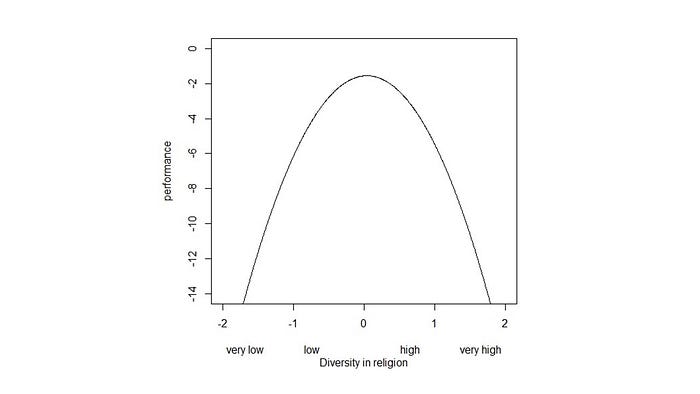
It appears that an inverted-U dependency applies to other fields. For example, a 2016 article describes the effects of team religious diversity — the degree to which team members differ in their religious beliefs — on the performance of 66 health teams in three large hospitals in Dubai, UAE, a predominantly Muslim country.
Usingthe proportion of Muslims vs. non-Muslims within a team as a measure of religious diversity, the authors found an inverted U-shaped relation between diversity and performance: moderate diversity was associated with higher performance, while homogeneous and highly heterogeneous teams underperformed moderately diverse ones (see the picture below, reproduced from the article).
Interestingly, the positive effect of moderate diversity on performance was stronger for teams charged with more complex tasks (e.g., surgical vs. clinical teams), which reminds us of the fact that the positive effect of social policies on innovation is especially strong in knowledge-intensive industries, such as technology and finance.
When more is too much
Another article analyzed the role of domain experts (people whose primary professional experience is within a specific industry) on the performance of corporate boards. The authors wanted to know how the proportion of domain experts affected the board’s performance.
They looked at financial data for 1,300 community banks and found that when banks faced increased levels of uncertainty, the higher proportion of domain experts on the board resulted in a higher likelihood of banks’ failure. The major problem with having too many domain experts was “cognitive entrenchment,” the inability of expert-dominated boards to effectively respond to new information or unfamiliar situations.
Sounds like “too much” knowledge and expertise harms performance. Weird, isn’t it?
In fact, we shouldn’t be surprised: our own experience tells us that many things in life are good “in moderation.” For example, at small doses, the rattlesnake venom can be used to treat arthritis and cancer, but it becomes deadly at larger doses. Similarly, we all long for attention from our loved ones, yet we begin protecting our space when this attention gets overwhelming.
So, in innovation, business — and life in general — dose is everything. You may remember this wisdom tonight when adding salt to a dish you cook for dinner.









 innovationobserver.com