
One more time about “culture of innovation”

My previous post, “The “culture of innovation:” misnomer, oxymoron, myth or chimera?”, has caused a lively discussion in a number of LinkedIn groups. Approximately half of the commenters were sympathetic to my claim that the very term “culture of innovation” is more a distraction than an enabler in attempts to promote corporate innovation. The other half adhered to the point of view that the “cultural” aspect plays a central role in the organizational ability (or inability) to innovate.

I’m very grateful to everyone who took the time to participate in the discussion. In this follow-up piece, I’d like to clarify and refine my position on the topic in response to the received feedback.

First of all, let me clearly state that by no means do I deny the importance of the cultural aspect of business operations. People are people, and the way they feel and behave does affect the manner they conduct business transactions. My specific objection is to the expansive usage of the word “culture” in the context of innovation.

Have you ever heard about a modern-day organization trying to establish a “culture of accounting”? No; organizations simply introduce solid accounting practices. Have you ever heard about an organization trying to establish a “culture of quality”? No; organizations adopt the Six Sigma methodology instead. Have you ever heard about “culture of sales”, “culture of marketing” or “culture of project management”? Nope. It’s only innovation that, in the mind of many, requires a “culture” to exist. Why?

The reason—and I wrote about it before—is that we still don’t consider innovation a normal corporate process, on par with manufacturing, sales, marketing or talent management. We’re still unsure what innovation is—a surprisingly large number of organizations even don’t have a working definition of what innovation means for them—and routinely equate it with occasional “idea generation” campaigns. We appoint Chief Innovation Officers, but give them neither line authority nor fixed budget (or a budget that can be promptly taken away in case of “emergency”). We don’t understands the difference between incremental, “adjacent” and radical innovation (a.k.a. the 3-Horizon Model of Innovation) and unfamiliar with the concept of Integrative Innovation Management. As a result, we believe that every innovation must be “disruptive,” while all other types of it are for losers.

This intellectual and organizational vacuum is being filled with endless talks about “culture of innovation,” which, when established (without explanation of what “established” means, either), will supposedly take care of the rest. This allows corporate leaders responsible for innovation to take a hand-off approach and claim instead that “in our organization, innovation is everyone’s job.”

That’s why I insist that instead of making hollow calls to “unleash creativity,” “fail fast and often” and “celebrate failure”—all usual suspects in “establishing” the “culture of innovation”–we begin designing and implementing specific corporate policies that would help innovation take roots in organizations. That’s why I insist that a real corporate innovation begins not with “culture,” but with structure and process. With structure and process in place—and after years of running multiple and repeated innovation programs, while communicating their results to the rest of the organization—hopefully, a habit of innovation will emerge. And if you want to call this habit culture, fine with me.

There is one more thing I’d like to emphasize strongly: the role of corporate leadership. Because nothing—and I want to repeat this, nothing—will happen in any organization aspiring to have real innovation without active personal involvement from the C-suite.

Let me illustrate this point with a story. A few years ago, a large multi-national company invited me to an opening ceremony to celebrate the launch of a major open innovation initiative in one of its leading R&D divisions. I was to represent a company that was providing an online platform and consulting services for the initiative.
Highlighting the importance of the occasion, the ceremony was attended by a very big R&D boss from corporate headquarters. In his pep talk, the boss (I’ll call him John) spoke about virtues of open innovation, about the importance of the new initiative and how everyone in this location had to try it. He customarily concluded his talk with: “Any questions?”

A young fellow in the crowd of scientists raised his hand. Apparently sensing an opportunity to impress the high-profile visitor, he said: “John, I’m so busy with my current projects. How can I find time to run an open innovation campaign and then go through a pile of external submissions, while running simultaneously multiple experiments?”

John looked at the young fellow for a few long seconds (too long, I thought) and responded: “Look, we’ve charged you with solving a problem that is important to the company and we want your project succeed. I personally don’t care how you do that. If running experiments is enough, fine. However, if you fail, we’ll ask you: what have you done—in addition to running your own experiments—to have this problem solved? And, please, don’t tell us then that you were too busy to go through a pile of external submissions.”

By the expression of the young fellow’s face—and by the silence that suddenly filled the room—I realized that John’s message got across. A culture of open innovation was just born in this R&D location.

Have a great summer everyone!

p.s. You can read the latest issue of my monthly newsletter on crowdsourcing here: http://mailchi.mp/324919f20cae/gaining-steam-overcoming-resistance. To subscribe to the newsletter, go to http://eepurl.com/cE40az.

Image created by Tatiana Ivanov

Posted in Innovation | Tagged , , , , , , , | 1 Comment

The “culture of innovation”: misnomer, oxymoron, myth or chimera?

In the opening piece of the Summer 2017 issue of MIT Sloan Management Review, Paul Michelman writes about diminishing importance of corporate culture in the age of networked enterprises. Obviously, not everyone agrees with Mr. Michelman, and the whole discussion just highlights our near-obsession with the “cultural” aspects of business operations.

Nowhere else has this phenomenon reached such an epic proportion as in our dealing with the proverbial “culture of innovation,” a subject whose popularity in business literature and social media can only be matched by the extreme fuzziness of its definition. However, in my opinion, the very term “culture of innovation” is a misnomer, if not an oxymoron.

No matter how you precisely define it, culture is about sharing: sharing perceptions, thoughts, beliefs and even behavior. But the implicit homogenization that the sharing tries to achieve is completely antithetical to innovation, which is about diversity. A growing body of evidence (summarized in a 2014 article in Scientific American) shows that socially diverse groups, that is, those with a diversity of race, ethnicity, gender and sexual orientation, are more innovative than socially homogeneous groups. It is exactly a conflict of backgrounds and experiences, not their sharing, that makes innovation happen.

Why then is the myth of “culture of innovation” so sustainable? I suspect that the major reason is that the frequent—and often empty– talk about it allows corporate leaders to take a hands-off approach when it comes to developing innovation strategy and establishing innovation processes.

I was quite amused to see the data presented in a recent PWC’s report on innovation surveying 246 CEO’s from around the world. The captains of industry cited “existing organization culture” as one of the top three obstacles preventing their companies from being more innovative.

Think about that for a minute! Why would a CEO view an “organization culture” as something that is completely out of their control, like a natural disaster or act of war? Is it not their direct responsibility to design and implement policies fostering this culture?

Apparently not. In recent years, many CEOs have mastered the art of talking about innovation, delivering well-rounded answers to friendly questions in non-confrontational surveys and interviews. But a frighteningly large number of them still demonstrate a cloudy vision of the very fundamentals of the innovation process. Too many CEOs don’t consider overseeing innovation process as part of their jobs, proudly claiming instead that “in our company, innovation is everyone’s job.” That’s where a non-stop talk about the culture of innovation comes so handy.

Instead of chasing chimeras, our corporate leaders should start implementing specific corporate policies helping innovation take roots in their organizations. In particular, they may try two things:

  1. Making stock option grants, as opposed to cash bonuses and other monetary rewards, the principal incentive for engaging employees in innovation projects.

This proposal is based on a 2015 finding that companies offering stock options to non-executive employees were more innovative, and that the positive effect of stock options on innovation was more pronounced with longer-term grants.

  1. Placing employees involved in innovation projects on fixed-term employment contracts, as opposed to employment-at-will. Alternatively, the creation of tenure-like job arrangements for people involved in strategic innovation initiatives can be considered.

This proposal is taking cue from a 2001 study showing that labor laws making it more difficult to fire employees increase their participation in corporate innovation activities. The authors of the study argued that the lower threat of termination produced by stronger anti-dismissal laws decreased the “cost of failure” for employees to engage in potentially risky innovation projects.

Of course, there is no guarantee that either of these initiatives will work. But they are at least testable and, even more importantly, measurable–as opposed to the hollow calls on the employees “to take risks,” “fail fast and often” and “celebrate failure.”

Real corporate innovation begins with structure and process. And if you keep perfecting them, while communicating the results to the rest of your organization, then sooner or later, a habit of repeated innovation will emerge. You want to call this habit culture? Be my guest.

p.s. You can read the latest issue of my monthly newsletter on crowdsourcing here: http://mailchi.mp/324919f20cae/gaining-steam-overcoming-resistance. To subscribe to the newsletter, go to http://eepurl.com/cE40az.

Image created by Tatiana Ivanov

Posted in Innovation | Tagged , , | 7 Comments

From a Spark to raging fire. (How Liberty Global got its corporate innovation right.)

Virgin Media Dogpatch. Picture Conor McCabe Photography

(This post has originally appeared on Edge of Innovation)

So many companies struggle with their corporate innovation programs that it’s important to identify and celebrate “success stories,” as there still aren’t many cases of organizations that get corporate innovation right. One such successful organization is Liberty Global, the world’s largest international cable company, known for its brands like Virgin Media, VodafoneZiggo, Unitymedia and Telenet. In 2016, Liberty Global was ranked 88th on the Forbes list of the World’s Most Innovation Companies.

Central to the Liberty Global’s innovation success is its program called Spark. Originally launched in 2011 at (then) UPC Netherlands and re-structured in 2013, Spark is an initiative aimed at sourcing, refining and implementing ideas proposed by Liberty Global’s employees and partners.

One of the original founders of Spark was Roel de Vries, who now manages the program at the Liberty Global’s Corporate Office in Amsterdam. In the fall of 2015, Roel explained to me Spark’s objectives, described early victories and also some struggles the initiative went through right at the beginning. Recently, I spoke with Roel again and asked him about the progress he and his colleagues at Spark have achieved over the past 18 months. Joining the conversation was Elaine Bromell, Program Manager at Virgin Media Ireland, a Liberty Global subsidiary. Below is a written version of our conversation.

E.I.: Roel, I know that you keep a meticulous count of all metrics related to the program. Could you please give the latest update of what’s happening at Spark in terms of numbers?

R. de V.: As of today, the Spark platform is available to more than 30,000 Liberty Global employees in 14 countries. Overall, more than 15,000 ideas have been generated, of which over 1,100 have been implemented; the total Return on Investment (ROI) stemming from the realization of these ideas is more than €10 million. But more importantly, over the past year or two, we’ve become much better at helping the Spark participants refine their ideas, make them look more attractive when presented to the company’s senior management. In turn, this led to the higher rate of idea adoptions and their subsequent implementations.

E.B.: Interestingly, we also spotted a feedback-loop effect of sorts: as the number of adopted and implemented ideas increased, so did the quality of submitted ideas. Certainly, the employees participating in Spark have realized that their efforts, which actually come atop their daily activities, are being noticed and appreciated by the company’s leadership.

E.I.: Roel, when we spoke last time, you told me that when originally launched in 2011, Spark was essentially no more than electronic suggestion box. The problem with this arrangement was that the majority of submitted ideas were of little practical value. They weren’t aligned with the company’s overall strategy. You then re-structured the program, in 2013, and began running it with the “end in mind’, that is, with aligning the idea flow to strategy. So now, while still running idea campaigns that don’t address specific questions (“always-open” campaigns), you pay more attention to so-called focused campaigns, campaigns that target a specific business or technical question. Are focused campaigns more successful than “always-open” campaigns?

R. de V.: Yes, they are. Asking a specific question sets the parameters for the ideas that people will generate. It gives them structure around the types of things we’re looking for, so the ideas that come in will have a better focus than those developed during a ”tell us what you’re thinking” type of open campaign. We always say: “It’s difficult to think outside of the box, if you don’t know what or where the box is.”

E.I.: Besides the efficiency of focused campaigns, are there other factors—perhaps, a specific issue or problem–that could predict a successful idea campaign?

R. de V.: Spark is organized in such a way that each idea campaign has a sponsor, who is typically a high-level department head or business unit manager. As typical for senior executives, they have a passion for cost savings. Consequently, they have a soft spot for idea campaigns aimed at optimizing internal operations that might result in cost reductions. Ideas submitted during such campaigns usually have a better chance to grab the attention of the company’s leadership and, therefore, a better chance of eventually being implemented. And, as Elaine has just mentioned, when employees feel that their ideas have a better chance of being noticed, they tend to submit higher-quality ideas. So, yes, idea campaigns aimed at cost reduction are, by and large, more successful than others.

This is, of course, not to say that our employees are bad at generating product or service ideas—no, they are good, and some of their ideas are simply awesome! It’s just that such ideas are more difficult to develop and more costly to implement.

E.I.: Recently, you’ve added another piece to your corporate innovation toolbox: a program called MatchBox. What is MatchBox? What was the problem you wanted to solve by launching it?

E.B.: Spark is generating a lot of ideas. However, we noticed that some of these ideas would stall—and not because they were low quality, but because their originators struggled to refine and develop them into attractive business propositions. First of all, many of our employees simply don’t have enough theoretical and practical knowledge in the area of idea development. Besides that, they often lack necessary resources—time and money—to convert their original thoughts into something tangible. We launched MatchBox to address this specific problem: the lack of knowledge and experience in the area of idea development.

So we started by bringing together 50 of the Virgin Media Ireland employees to an offsite workshop and giving them a two-day, extensive MatchBox training. Prior to the training, we made an agreement with management that the participants would be allowed half a day per week to work on their ideas.  We also gave to each participant a pre-paid credit card to cover expenses, if necessary. After two months of work and development, 15 participants made it through all six levels of the MatchBox program and presented their business cases to the company’s executive team, at Spark Pit, an exciting event modeled after the popular TV show “Dragons’ Den” (“Shark Tank” in the U.S.). Eight of the 15 presented ideas were elevated to the next level – Blue MatchBox. Being elevated to the Blue MatchBox category means that the management believes in the value of this particular idea and that a working team will be created to bring this idea to implementation. We’re happy to report that one idea has already been implemented in Ireland.

E.I.: What happened to the MatchBox participants whose ideas weren’t selected?

E.B.: Well, they went back to their daily routines, so to speak, but the participation in the program had a clear positive impact on them. First, they now have a valuable knowledge that they can apply in the future. They also got innovation “fervor,” and many of them have already engaged in new idea campaigns.  We also find that “MatchBoxers” continually submit ideas of very high quality! We fully expect these people to become innovation champions throughout the whole organization.

E.I.: Let’s talk about communication. Liberty Global has operations in over 30 countries. So in addition to connecting people with diverse expertise and training, working for different departments and business units—a challenge that is faced by all organizations launching innovation programs—you have to bring together employees speaking, literally, different languages. How do you deal with this kind of a challenge?

R. de V.: Over a year ago, Sarah Kelly joined me on the Spark team as the Innovation Network Manager; Sarah now plays the key role in our communications. With eight years in the company and a natural talent for connecting with people, she’s brought with her a large network that helps in linking subject matter experts with idea owners. For our global campaigns, Sarah writes all communications to share with our global teams. We strive to make English our common innovation language, and as a native speaker, Sarah can tell a story in a way that gets our message across simply, for everyone.

At the same time, it’s not a secret that some employees, for whom English isn’t their first language, may experience difficulties in expressing themselves when it comes to complex technical or business topics. We don’t want the language barrier dampening their enthusiasm for innovation. So, employees can now participate in Spark in their own languages in addition to English. At each location, our Spark managers and innovation champions provide support in translating documents written in English into local languages and vice versa. We’re also looking into opportunities to replace this human support with technology.

E.I.:  Finally, I’d like to ask you about proverbial “culture of innovation.” I noticed that you haven’t been using this term during our conversation. Why? Do you not believe that the “culture of innovation” is real?

R. de V.: Not at all: the cultural aspect of corporate innovation programs is very important. I believe that we do have a “culture of innovation” at Liberty Global; however, we don’t talk much about it, and I’d be troubled to give you a precise definition. I think that we have at least three major components of a bona fide innovation culture. First, we have created an atmosphere of openness to new ideas. Second, we have succeeded in creating a common, company-wide, language of innovation. Third, and perhaps, the most important, we have a tremendous support from our executive leadership, support that goes all the way up to the corner office of the company. So the culture in our organization is definitely shifting and it’s shifting both top down and bottom-up—exactly how we’d like it!

E.B.: We’re already witnessing some tangible results of this shift, as employees participating in the Spark program consistently score higher than other employees in engagement surveys. So we’ll continue to invest in our people and we’ll continue to perfect our programs. And we believe that if we do these things right, the “culture” will take care of itself.

p.s. You can read the second issue of my monthly newsletter on crowdsourcing here: http://mailchi.mp/b3e5728661b4/yes-to-science-no-to-betting. To subscribe to the newsletter, go to http://eepurl.com/cE40az.

Posted in Global Innovation, Innovation, Internal Innovation Networks | Tagged , , , , , , , , | 2 Comments

Crowdsourcing expertise from “generalists”

Recently, I came across an interesting article—and it was its title, “Why Experts Have Killed Innovation,” that attracted my attention. The author, Joshua Krook, a doctoral candidate in law at University of Adelaide, points out to the rising specialization of the global workforce and claims that education and training focused on increasingly narrow skills, for increasingly narrowly-defined positions, has a “dampening effect on innovative thought and creativity.” While truly innovative ideas tend to come from generalists operating at the intersections of various disciplines, argues Krook, we keep churning out specialized experts.

There is one more, equally damaging, effect of specialization on innovation: the time it takes. More and more professional positions associated with “innovation” now require applicants to have an advanced degree: MS or even PhD. As a result, instead of producing inventions in their twenties and thirties—arguably the most productive years for creative activities—young people spend this time on acquiring degrees that would only allow them to get hired for “creative” jobs. No surprise that the average age of Nobel Prize winners keeps steadily increasing (by 5-6 years per century).

Krook offers what he calls a “simple” solution to the specialization problem: companies should stop hiring experts in a particular filed and start hiring generalists (“capable of thinking outside the box,” as he puts it). Companies would also benefits from hiring independent outside innovators that had escaped the pressure of specialization.

As much I like the way Krook defines the problem, I’m very skeptical of his “simple” solution. The hiring process in most organizations, as formal and antiquated as it is, is intrinsically incapable of identifying qualified “generalists” (even if HR staffers would succeed in defining what “generalist” means for this particular organization).

And yet, there is a proven solution to the problem of workforce specialization: crowdsourcing. First, crowdsourcing allows an organization to temporally “hire” people who’re external to it and therefore unencumbered by the organization’s narrowly defined expertise. Second, launching a crowdsourcing campaign—using an appropriate venue—absolves the organization from the very need to actively look for qualified people (whether “experts” or “generalists”): qualified individuals will self-select and appraoch the organization with their solutions. Third, academic research on crowdsourcing shows that the likelihood of someone solving a problem increases with the distance between this person’s own field of technical expertise and the problem’s domain. This suggests that a properly designed crowdsourcing campaign may result in a breakthrough invention emerging from the interplay of different scientific and/or technological fields.

Crowdsourcing is not the only way to enrich the internal expertise with diversity originating from external crowds. Recently, a concept of crowdraising has been proposed by CrowdRaising.co, a NYC-based startup. (Full disclosure: I’m a member of the CrowdRaising.co Advisory Board.) Crowdraising allows crowds to pledge time instead of money to support causes they like. Any organization running an innovation project can now hire a crowd to perform business-related activities. These activities could be as simple as taking part in a survey or beta testing, or they could involve more complex tasks, such as coding, design work or strategic advice.

Taken together, crowdsourcing and crowdraising may create a new paradigm of finding and utilizing employees in the gig economy. But at the very minimum, they can help companies avoid a trap of “hyper-specialization.”

p.s. You can read the second issue of my monthly newsletter on crowdsourcing here: http://mailchi.mp/b3e5728661b4/yes-to-science-no-to-betting. To subscribe to the newsletter, go to http://eepurl.com/cE40az.

Posted in Crowdsourcing | Tagged , , , , , , , | Leave a comment

Innovating on Facebook

Customer feedback represents a rich source of ideas for product innovation. However, the traditional methods of customer feedback collection– surveys, focus groups and ethnography–are labor-intensive and costly, so that only large and resource-rich firms can take full advantage of this approach.

An alternative way of collecting customer feedback is netnography: gathering insight (needs and wants) of social-media-active consumers by following their conversations on various online forums, in particular, social networks and microblogging services. Due to its ability to generate a lot of data points at only a fraction of the cost of traditional methods, netnography is available not only to large, but small companies as well.

Obviously, Facebook represents potentially the most useful netnography venue. Boasting 1.94 billion monthly users and hosting 60 million business pages, Facebook looks like a particularly attractive source of customers’ product ideas. But does Facebook really deliver on this promise? A recent study provides a positive answer to this question.

Irene Bertschek and Reinhold Kesler (from the Centre for European Economic Research) have conducted a study of the role that customers’ Facebook activities play in the corporate innovation process. The study shows that the adoption of a Facebook page and actively soliciting customer feedback has a significant positive effect on the firm’s product innovation. Interestingly, it’s the negative user comments on Facebook that were especially instrumental in improving existing products and creating new ones. It’s also interesting that collecting customer feedback positively correlated with product, but not process innovation, an observation consistent with my prior note that external “crowds” are usually inefficient when applied to optimizing internal processes.

Previously, I described another study that found, perhaps, to a surprise of many, that product ideas generated by external users were better (in terms of novelty and customer benefits) than those proposed by a firm’s own professional designers. Moreover, it was found that the ideas that received the highest marks overall came predominantly from the outside users.

Taken together—and interpreted within a broader concept of “consumer innovation”–both studies strongly suggest that input derived from crowds of external users, including customers, can be applied to the whole chain of product innovation: from collecting customer feedback to generating product ideas. It may well be that in the future firms’ competitive advantage will be determined not by the creativity of their internal R&D teams, but, rather, by the firms’ ability to attract the most creative crowd of external users.

p.s. You can read the second issue of my monthly newsletter on crowdsourcing here: http://mailchi.mp/b3e5728661b4/yes-to-science-no-to-betting. To subscribe to the newsletter, go to http://eepurl.com/cE40az.

Image Credit: http://www.italiangoodnews.com/eurostat-community-innovation-survey-italian-enterprises-among-innovative/

Posted in Innovation | Tagged , , , , , , , , , , | Leave a comment

Innovation portfolios, innovation toolboxes

Proposed by Ralph-Christian Ohr model of integrative innovation management is a set of practical recommendations that allows organizations to adopt a disciplined approach to the innovation process. Central to the model is the idea that organizations must build a balanced portfolio of innovation projects composed of both exploitation- and exploration-type initiatives arranged along the following three strategic horizons:

  • Core Innovation: optimizing existing products and business models for existing customers;
  • Adjacent Innovation: expanding to the “new to the company” markets;
  • Transformational Innovation: creating principally new products and business models to serve markets and customer needs that may not yet exist.

The major benefit of the 3-horizon innovation framework is that it shows to organizations how to structure, govern and, most importantly, fund innovation programs while successfully managing risks. Unfortunately, as formulated, it is silent with respect to specific innovation tools that organizations should use when approaching different innovation horizon.

Earlier, I proposed a “map” of open innovation tools and attempted to match some of these tools (here and here) to specific stages of business model innovation. In this piece, I want to discuss how three different open innovation tools—customer co-creation, engaging startups and external crowdsourcing—could be applied to the three innovation horizons.

I believe that customer co-creation is the most efficient when applied to the Core Innovation, when organizations deal with incremental improvements of their existing products and slight tweaks of their business models. This stems from the two-way interaction nature of customer co-creation that provides opportunities for early customer feedback, which allow organizations to rapidly test hypotheses and Minimally Viable Products (MVPs).

The ability of providing immediate feedback to MVPs expands the usability of customer co-creation into Adjacent Innovation. However, its efficiency here appears to be lower than in the Core Innovation horizon, because customers may have trouble to articulate their unmet needs when it comes to new products. It is for this particular reason—the inability to express the needs for something (be it a product or a service) that doesn’t yet exist–that customer co-creation becomes virtually useless in the case of Transformational Innovation.

This pattern gets reversed for engaging startups: this approach is useless when applied to Core Innovation, gains some strength in the Adjacent Innovation horizon and is at its best when used for Transformational Innovation. By their very nature, startups—at least the best of them–are entities created for the purpose of transformational change of the existing technology and/or business landscape. By engaging startups, organizations would “hire” players with the creativity, flexibility and audacity to challenge status quo that can rarely be found within internal R&D teams in most mature organizations.

I’m not saying that engaging startups is making Transformation Innovation easy. What I’m saying is that by creating a vibrant startup ecosystem, organizations can make this type of innovation possible and, perhaps, even sustainable. I’d even go as far as to claim that for the vast majority of large and mature organizations, engaging startups is the only Transformational Innovation tool they can use with repeated success.

Crowdsourcing stands out among other open innovation tools in the sense that it can be used, equally successfully, in all three innovation horizons. The reason for this “omnivorousness” lies in the very nature of crowdsourcing as an innovation tool. Crowdsourcing is essentially a question that one asks a crowd of people; the nature of the answer one receives from the crowd is determined, first and foremost, by the nature of the question. By properly formulating questions addressing problems and issues of increasing difficulty, complexity, time horizon, risk and ambitions—and helping crowds to come up with plausible answers to these questions–organizations can successfully apply crowdsourcing to all innovation horizons.

Now, again, I’m not saying that crowdsourcing is easy; before, I pointed out at its limitations at some stages of business model innovation. My point here is that the onus of properly formulating a question is on organizations—and this is something that can be learned—whereas crowds, as they have shown time and again, can come up with an answer to pretty much any question, regardless of its scope and nature.

p.s. You can view the first issue of my monthly newsletter on crowdsourcing here: http://mailchi.mp/79401a1a6ae8/crowdsourcing-laws-budgets-and-psalms. To subscribe to the newsletter, go to http://eepurl.com/cE40az.

Posted in Innovation | Tagged , , , , , , , , , , , , , , | 8 Comments

Know your customers and trust them too

Customer centricity—a framework that places the customer at the center of business operations—is gradually becoming a leading paradigm for new product and services development. Many firms employ a variety of marketing tools, including ethnography and netnography, to identify unmet customer needs (“jobs-to-be-done”) that could be potentially addressed by novel and, supposedly, improved offerings.

However, after the customer input has been collected and systematized, customer centricity gets rapidly forgotten, as the firms turn exclusively to internal R&D teams to address the newly identified customer needs. As the prevailing thinking has it, it’s only the firm’s own professionals (marketers, product developers, engineers, etc.), but not the customers, who have the knowledge and experience to come up with working ideas that could be realized in commercially successful designs.

Ironically, the assumption that the customers know what they need, but don’t know how to make it, is seldom tested—and, when tested, is proven wrong. In a 2012 article published in The Journal of Product Innovation Management, Poetz and Schreier compared novel product ideas generated by a firm’s professionals with those submitted by a “crowd” of users. The field of innovation was baby feeding products, and all the ideas were evaluated, blindly to their source, in terms of novelty, customer benefit and feasibility.

The study showed that the ideas generated by the users scored significantly higher in terms of novelty and customer benefits–and only slightly lower in terms of feasibility–than those proposed by the firm’s own designers. Moreover, it was found that the ideas that received the highest marks overall came predominantly from the outside users. So much for the internal expertise!

It’s tempting to argue that Poetz and Schreier’s study is an exception. As already mentioned, the field of innovation was baby feeding; the analysis of the users who took part in the idea generation process revealed that about 90% of them were females, many with firsthand experience in feeding babies and a sound technical knowledge of the related products. It’s easy to imagine how a recent mom with a solid technical background can come up with better ideas for baby feeding products than a (presumably all-male) team of professional designers. (As my wife often complaints, her hair dryer must have been designed by a bunch of bald males.)

Although I’d love to see Poetz and Schreier’s study replicated in other settings and different industries, I do believe that it has much broader implications. It yet again dispels a popular myth that crowds of problem solvers are composed of “amateurs” and that when answering a question requires knowledge and expertise, not just an opinion, crowds are becoming useless (or outright stupid). The truth is that properly assembled crowds are composed of experts. They may not work for your company, or in your field, or in your country; but they’re experts nonetheless.

To prove this point, one only needs to take a look at InnoCentive, a commercially available crowdsourcing platform with a solid track record of solving difficult scientific and business problems for corporate and non-profit clients. The InnoCentive proprietary crowd is composed of 375,000+ solvers, with 66% of them holding advanced degrees. I strongly suspect that some of them are women with a substantial experience in feeding babies.

p.s. You can view the first issue of my monthly newsletter on crowdsourcing here: http://mailchi.mp/79401a1a6ae8/crowdsourcing-laws-budgets-and-psalms. To subscribe to the newsletter, go to http://eepurl.com/cE40az.

Image Credit: http://www.superhealthykids.com/feeding-your-baby-solid-food-101/

Posted in Crowdsourcing, Innovation | Tagged , , , , , , , , , , , | 8 Comments

Are crowds stupid?

We have been talking about the wisdom of crowds for so long and with such a passion that it was only a matter of time that someone would decide to call crowds stupid. And here it comes: Aran Rees, “a creativity coach, facilitator and communicator,” published what looks like a bona fide anti-crowdsourcing manifesto, “The Stupidity of Crowds.”

As a proof that crowds are stupid, Rees cites two recent examples. First, he mentions an attempt by a British government agency to crowdsource a research ship’s name, a process that ended up with the public having chosen a completely ridiculous option. Rees’s second example is Brexit, a decision by the British public, expressed during a 2016 referendum, to leave the European Union.

To me this sounds like shooting the messenger when you don’t like the message. Crowdsourcing is, first and foremost, a question that you ask a crowd; the quality of the question is the most important determinant of the quality of the answer. You ask the crowd a smart question–you have a chance to get a smart answer. You ask the crowd a stupid question–the answer will almost certainly be stupid.

I’d agree with Rees that asking crowds to come up with names and then vote for them is a stupid idea. So, in my opinion, was the idea of putting to a referendum the U.K.’s membership in the EU. But why should the blame rest with the crowds? Blame crowdmasters, the people who have posed these stupid questions to the crowds! Besides, as a matter of sheer decency, should we automatically call stupid people who have tastes, sense of humor and political preferences different from ours?

Rees’s criticism of crowds and crowdsourcing troubles me for two additional reasons. The first is his habit—unfortunately, a very common one—of overemphasizing the “crowd” part of the word “crowdsourcing.” Rees and many others tend to call crowdsourcing almost any activity involving a large group of people, especially if these activities happen online. But the original—and still, in my opinion, the best—definition of crowdsourcing, proposed by Jeff Howe in 2006, describes it as “the act of taking a job traditionally performed by a designated agent (usually an employee) and outsourcing it to an undefined, generally large group of people in the form of an open call.”

In other words, crowdsourcing is not just about a crowd; it’s about outsourcing a job. Asking people to vote in a survey or referendum is not outsourcing a job, at least not in the sense most organizations and reasonable people would define the term “job.” That’s why, by the way, in contrast to what Rees thinks, Facebook and Twitter are not crowdsourcing venues. (As Henry Mintzberg shrewdly suggested, ask your Facebook friends to help paint your house.)

The second problem is that Rees reduces crowdsourcing to simply generating ideas and/or voting for them. He thus rhetorically asks: “Do you suppose that someone taking five minutes to respond to a survey and someone else taking ten second to vote is likely to result in deeply thought out insights?”

Is this how Rees understands crowdsourcing? Has he ever heard about NASA using crowdsourcing to crack previously intractable space exploration problems? Has he ever heard about tremendously successful “Ebola Grand Challenge” sponsored by the USAID? Has he ever heard about open innovation boutiques, such as InnoCentive and NineSigma, which turned crowdsourcing into commercially viable business opportunities by serving, with very impressive success rate, their corporate, government and non-profit clients?

Crowdsourcing is extremely powerful problem-solving tool, but as any other tool, it requires knowledge and experience to be properly used. Those who know how to use crowdsourcing will succeed in harnessing the proverbial wisdom of crowds. Those who don’t won’t. It’s this simple.

Image Credit: http://www.bbc.com/future/story/20150324-the-hidden-tricks-of-persuasion

Posted in Crowdsourcing | Tagged , , , , , , , , , , , , | 3 Comments

Applying open innovation tools to business model innovation

Recently, I proposed a “map” of existing open innovation tools based on the identity of open innovation partner(s) and the mode of interaction between them. Three large “baskets” were included: co-creation (known partners, two-way interaction), crowdsourcing (unknown partners, two-way interaction) and webscouting (unknown partners, one-way interaction). I further suggested that the proposed map may help in matching specific open innovation tools with different types of innovation.

In the first example of such matching, I looked at the usefulness of internal and external crowdsourcing at three stages of business model innovation, the latter being defined by C.M. Christensen, T. Bartman and D. van Bever”as follows:

  • Market-creating innovations, the type of innovation that takes place at the first stage of business model formation when firms search for a meaningful value proposition,g., product or service that would fulfill unmet customer needs (“job to be done”).
  • Sustaining innovations, the type of innovation, which is an improvement in the firm’s core offerings, involving the creation of better products or services that can be sold for higher prices to existing customers.
  • Efficiency innovations, the type of innovation that kicks in when sustaining innovations no longer generate additional profitability and the firms turns to cost reduction, mainly by optimizing internal processes.

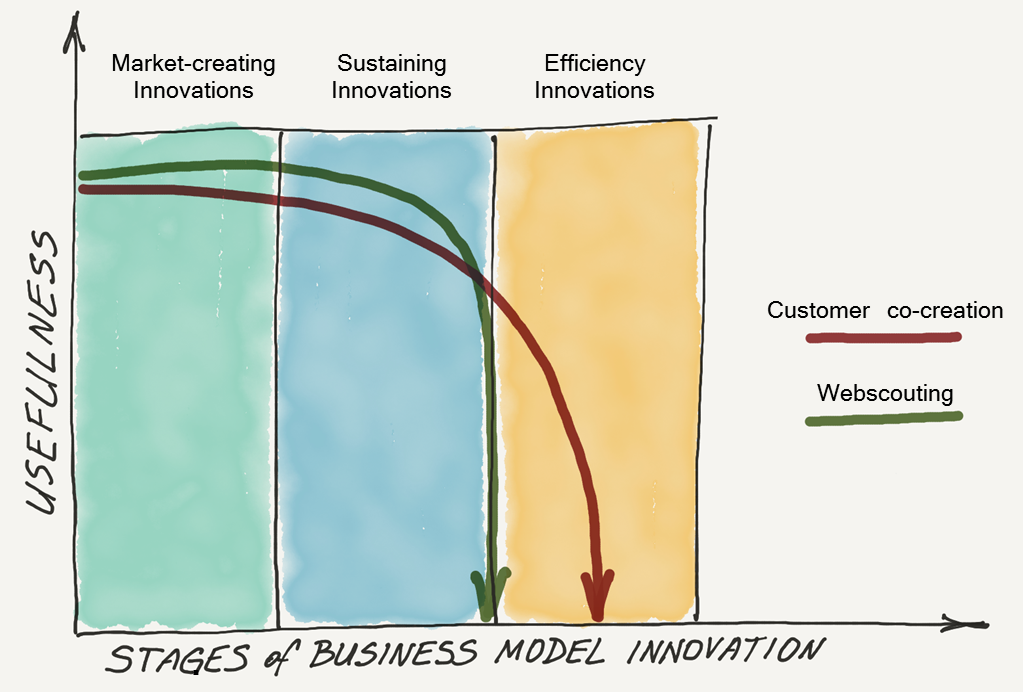
Here, I want to explore a match between stages of business model innovation and two other major open innovation tools: customer co-creation and webscouting.

The usefulness of both customer co-creation and webscouting is the highest when applied to market-creating innovations, the process of designing new products and services. Webscouting – in particular, netnography – would be indispensable in discovering unmet customer wants and needs. Its benefits include the ability to scout large numbers of potential customers and being less intrusive and expensive than ethnography and focus groups, two popular techniques in the customer co-creation basket. At the same time, the two-way interaction nature of customer co-creation provides opportunities for early customer feedback, allowing firms to test hypotheses and MVP’s. Using both tools in parallel may have a synergistic effect on the productivity of internal R&D teams.

Customer co-creation and webscouting are still highly effective when applied to sustaining innovations, allowing firms to collect customer feedback to their products and services. Again, using both tools in parallel would be the most beneficial as the depth of interaction with customers obtained through customer co-creation would be augmented by the large number of data points collected with the help of webscouting.

Webscouting, which, by definition, is the collection of customer insight on online forums, simply doesn’t apply to efficiency innovation. But customer co-creation, too, completely loses its power at this stage of business innovation: no customer, however close and trusted, can possess enough relevant information to be able to provide valuable insight with regards to the firm’s internal operations and cost structure, the hallmark of efficiency innovation.

The usefulness of customer co-creation and webscouting closely mirrors that of external crowdsourcing, which, too, is very efficient at the market-creating innovations stage, but gradually loses its efficiency at later stages. So far, I’m aware of only one open innovation tool that could be successfully applied to the efficiency innovation stage: internal crowdsourcing. That being said, I fully realize that the very classification of internal crowdsourcing (i.e., crowdsourcing conducted within the legal boundaries of the firm) as an open innovation tool could be questioned.

I’d also like to add that when talking about customer co-creation I had in mind the group of techniques specifically engaging existing and prospective customers, lead users (and, to a lesser extent, suppliers and academic and business partners). Left aside were approaches involving engaging startups (startup incubators/accelerators, joint ventures, etc.) that I also consider tools in the larger co-creation basket. Matching these open innovation tools to different types of innovation deserves separate analysis.

Posted in Open Innovation, Portfolio Management | Tagged , , , , , , , , , , , , , | 3 Comments

Why does your doctor hate crowdsourcing?

One of the signs of the growing popularity of crowdsourcing is its steady expansion into gated professional communities dominated by experts. Take, for example, medical diagnostics, an area that has for centuries been a fiefdom of medical professionals. Now, a bunch of platforms (CrowdMed being, perhaps, the most prominent) has emerged to provide patients with online medical diagnosis, especially diagnosis of rare conditions that have been missed by doctors.

Hardly surprisingly, the visitors aren’t particularly welcome. Back in September, I wrote about Dr. Joshua Liao, a resident physician in the Department of Medicine at Brigham and Women’s Hospital and a clinical fellow in medicine at Harvard Medical School, who used the pages of the Boston Globe to express his grudge against crowdsourcing.

Dr. Liao was approached by son of his patient, asking the doctor about CrowdMed as a potential help in establishing diagnosis for the patient’s mother. Dr. Liao’s response was no. He explained that a solid diagnosis requires not only patient’s medical history, which supposedly can be provided to a crowd, but, more importantly, direct medical examination of the patient, which can be not. For this reason, in his opinion, services like CrowdMed “produce more questions than answers, and more confusion than direction.”

I see Dr. Liao’s point, because I do understand the value of in-person medical examination. What troubles me with his argument is at least a dozen of “patient success stories” posted to the CrowdMed website, the testimonies by the people who were apparently helped by the crowd after their own doctors failed to do so. How are we to treat these “success stories”? As a fluke? As fake news, a popular accusation these days? Or as examples that in some cases, in spite of what Dr. Liao says, crowdsourcing can really deliver something that a single expert, however accomplished and experienced, can’t?

(And, mind you, I’m not even touching upon a sensitive issue of diagnostic mistakes committed by doctors themselves – a whopping 12 million a year of them – that account for 210,000 to 440,000 U.S. deaths annually).

As you can imagine, Dr. Liao isn’t the only doctor who hates crowdsourcing. Just a few days ago, I came across a piece written by Dr. Jeff Russ, a pediatrician. Dr. Russ’s criticism of crowdsourcing (which he attributes to the rise of medical “populism”) is arguably more grounded and sophisticated than Dr. Liao’s. And yet, when Dr. Russ insists that “crowdsourcing [relies] on the hope that sufficient quantity will outweigh…quality”, I can’t stop from asking myself whether Dr. Russ understands what crowdsourcing really is.

Crowdsourcing is not about quantity; it’s not even about quality. It’s about diversity. Crowdsourcing works not because crowds can generate numerous responses of varying quality, but because crowds can come up with unexpected, often completely unorthodox, solutions. And it’s the lack of diversity – diversity of opinions, sources of information and experiences – that forces professionals, in the medical field and elsewhere, to commit mistakes.

So I have a simple advice for Dr. Liao, Dr. Russ and his colleagues: don’t reject crowdsourcing; embrace it. Accept crowdsourcing as one of the many diagnostic tools in your repertoire. Obviously, there is no need to run a crowdsourcing campaign in case of a simple cold. However, when dealing with a complicated, potentially life-threatening, case (as the one described by Dr. Russ in his piece), use crowdsourcing as means of last resort, after all other diagnostic approaches have been exhausted. You may come up with nothing – well, no harm is done then. You may come up with a bunch of trivial ideas that you already tried and rejected – well, you know now that at least you haven’t missed something obvious. Or you may come across a suggestion that you never thought about – because it’s so unexpected and unusual. It might not work in the end, true, but it will push your thoughts in the direction you didn’t envision before.

Worse a try, if a patient’s life is in danger (if you ask me, a patient).

Image credit: http://www.kevinmd.com/blog/2016/06/are-you-the-physician-who-yells.html

Posted in Crowdsourcing | Tagged , , , , , , , , | 1 Comment